From Aristotle to ChatGPT: How AI Discovers Universal Patterns in Human Reasoning
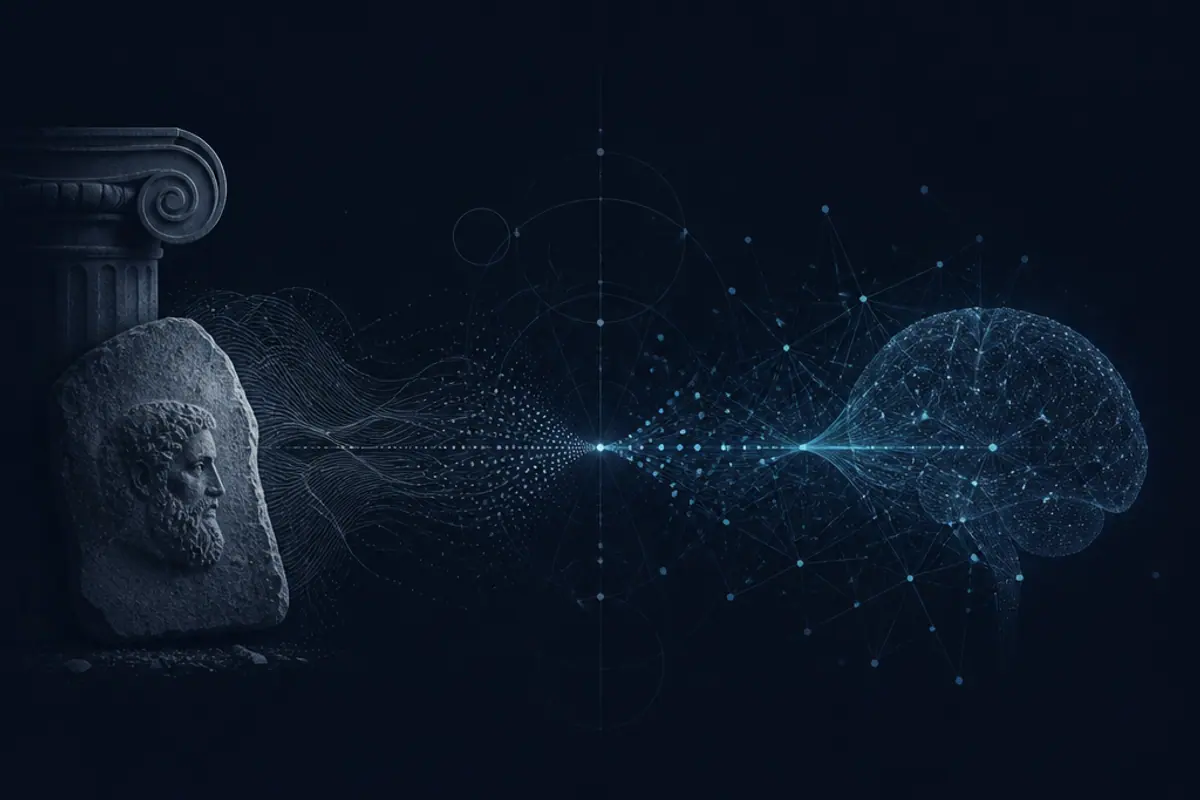
Pattern discovery in AI is the process by which large language models identify recurring structures in language and meaning from vast amounts of text, much as Aristotle once identified recurring patterns in persuasive speech. When we consider how ChatGPT and other LLMs discovers logical patterns by analysing vast amounts of text, we are drawing a profound parallel to one of history's greatest intellectual breakthroughs. Twenty-four centuries ago, Aristotle made a similar discovery by listening to orators in the Athenian agora - and the connection reveals something remarkable about how intelligence, both human and artificial, discovers universal principles.
Aristotle's Original Pattern Recognition
Around 350 BCE, Aristotle noticed something extraordinary whilst observing public speakers. Some arguments convinced audiences whilst others fell flat, regardless of the specific topic. Whether speakers discussed war with Persia or domestic politics, certain patterns of reasoning consistently proved persuasive.
Aristotle's breakthrough was recognising that these patterns had nothing to do with the specific content. He could abstract the structure - "if P then Q" - from the particulars about Persians, Greeks, cats, or dogs. This abstraction became formal logic, one of humanity's most powerful intellectual tools.
The method was revolutionary: observe large amounts of human communication, identify recurring patterns, then extract universal principles that apply regardless of specific content. Sound familiar?
ChatGPT's Digital Aristotelian Method
Modern large language models follow a strikingly similar approach. Instead of listening to orators in the agora, ChatGPT analyses trillions of words from human communication across the internet. Like Aristotle, it identifies patterns that transcend specific content - but it goes far beyond simple logical structures.
Where Aristotle discovered rules like syllogistic logic, AI systems discover what we call "semantic grammar" - deeper structural principles that govern how meaning operates in language. These aren't just logical relationships, but complex patterns about how concepts relate, transform, and interact.
For business leaders, this parallel reveals both the power and the challenge of modern AI: systems that can discover universal principles from data, but whose discoveries may not align with your specific requirements.
The Evolution from Templates to Computation
Aristotle's syllogisms were essentially templates - specific patterns like "Barbara" and "Celarent" that medieval scholars memorised as valid argument forms. This template-based approach dominated logical thinking for over two millennia.
George Boole's breakthrough in the 1830s moved beyond templates to true computation - Boolean algebra allowed arbitrarily complex logical operations that couldn't be reduced to memorised patterns. This computational leap enabled the digital age.
Modern AI represents another evolutionary step. AI systems discover semantic laws that operate more like Boole's computational rules than Aristotle's templates, but they apply to meaning rather than just formal logic.
What AI Discovers That Aristotle Missed
Wolfram suggests that Aristotle "stopped too quickly" - there were additional layers of structure in language that formal logic couldn't capture. AI systems have discovered some of these additional patterns:
Transitivity Rules: Location relationships are transitive (A to B, B to C means A to C), but friendship relationships are not. AI systems learn these distinctions without explicit programming.
Context-Dependent Reasoning: The same logical pattern might be valid in one domain but invalid in another. AI systems learn to apply different reasoning rules based on context.
Semantic Algebras: Complex operations on meaning that follow mathematical-like rules but operate on concepts rather than numbers.
Pragmatic Inference: Understanding what communications accomplish beyond their literal meaning - promises, threats, commitments, and social signals.
Implications for Business AI Deployment
This pattern discovery capability creates both opportunities and risks for organisations:
Opportunity: AI systems can identify subtle patterns in your business domain that human experts might miss, potentially revealing new insights about customer behaviour, market dynamics, or operational efficiency.
Risk: AI systems might apply patterns learned from general internet text to your specific business context, where those patterns are inappropriate or harmful.
Compliance Challenge: The discovered patterns may conflict with regulatory requirements, ethical standards, or business policies that weren't represented in training data.
The Validation Challenge: Beyond Pattern Discovery
Here's where the Aristotelian parallel becomes instructive. Aristotle didn't just discover logical patterns - he validated them through systematic application and testing. His syllogisms worked because they captured genuine universal principles.
Modern AI systems excel at pattern discovery but struggle with validation. They cannot reliably evaluate whether their discovered patterns are appropriate for your specific context, just as Aristotle's students needed external verification that they were applying syllogisms correctly.
This creates a critical requirement for independent validation of AI reasoning patterns, particularly in regulated industries where pattern misapplication can have severe consequences.
The Computational Universe Beyond Human Interest
AI systems could theoretically discover and apply many types of computational patterns, but they're specifically trained to focus on those that humans find meaningful and useful.
This highlights a key business consideration. Your AI system's discovered patterns are filtered through what humans historically valued in communication. As business requirements evolve or enter new domains, you need processes to verify that these inherited patterns remain appropriate.
Designing Modern Validation for Ancient Wisdom
The parallel between Aristotelian logic and modern AI suggests a validation approach:
Systematic Testing: Just as logic students practised syllogisms across many examples, AI systems need comprehensive testing across diverse scenarios relevant to your business.
Domain-Specific Validation: Aristotle's logic was universal, but its application varied by domain. Similarly, AI patterns need validation within your specific business context.
External Verification: Logic teachers verified student understanding through external assessment. AI systems need independent validation to ensure discovered patterns serve business objectives.
Continuous Evolution: Logic evolved from Aristotelian templates to Boolean computation. AI validation must evolve to address increasingly sophisticated pattern discovery.
From Discovery to Governance
The Aristotelian parallel illuminates why comprehensive AI governance frameworks are essential. Pattern discovery is just the beginning - governance ensures those patterns serve human purposes responsibly.
This requires moving beyond amazement at AI capabilities to systematic validation of AI reasoning. The goal isn't to limit AI's pattern discovery ability, but to ensure discovered patterns align with business requirements, regulatory obligations, and ethical standards.
The Next Chapter in Pattern Discovery
As AI systems become more sophisticated at discovering semantic patterns, the validation challenge grows correspondingly complex. Organisations that master this challenge - combining AI's pattern discovery with robust validation frameworks - will gain significant competitive advantage.
The future likely holds AI systems that can make their pattern discovery more transparent, perhaps evolving toward the computational clarity Boole achieved for logic. Until then, success requires embracing both AI's Aristotelian insight and the validation discipline that makes insights useful.
Harness AI's pattern discovery power with appropriate validation safeguards. Explore how VerityAI ensures discovered patterns align with your business requirements through comprehensive behavioural testing.
Frequently asked questions
What is pattern discovery in AI?
Pattern discovery in AI refers to the way large language models identify recurring structures in language, meaning, and reasoning by analysing enormous volumes of text. Rather than being told explicit rules, the model infers them from examples, similar in spirit to how Aristotle inferred rules of logic from listening to persuasive speech.
Why does pattern discovery matter for business AI deployment?
Patterns an AI system learns from general internet text may not fit a specific business context, industry, or regulatory environment. Understanding that these patterns are inherited rather than purpose-built helps a business know where independent validation is needed before relying on AI outputs.
Can AI validate its own discovered patterns?
Generally, no. AI systems are good at finding patterns but not at reliably judging whether a given pattern is appropriate for a specific business or regulatory context. That judgement call needs external, human-led validation, particularly in regulated industries.
How does this connect to AI governance?
Pattern discovery is the starting point; governance is what ensures the patterns a system relies on are checked against business requirements, ethical standards, and regulatory obligations before being trusted in decision-making.
For hands-on help, see VerityAI's responsible AI governance.

Sotiris Spyrou
Sotiris Spyrou is the founder of VerityAI, a Responsible AI advisory for boards and AI-deploying businesses. With 27 years across agencies and global in-house roles, including Global Head of SEO at Robert Half and Group Head of Search at Gamesys, he advises leaders on AI governance and risk, and on answer-engine visibility engineered without the dark patterns the rest of the industry is getting penalised for. He is the author of TRANSFORM, AI Moats, and Ethical AI.
Founder at VerityAI
Areas of Expertise: