The Evolution of AI Threats: From Innovation to Cognitive Warfare
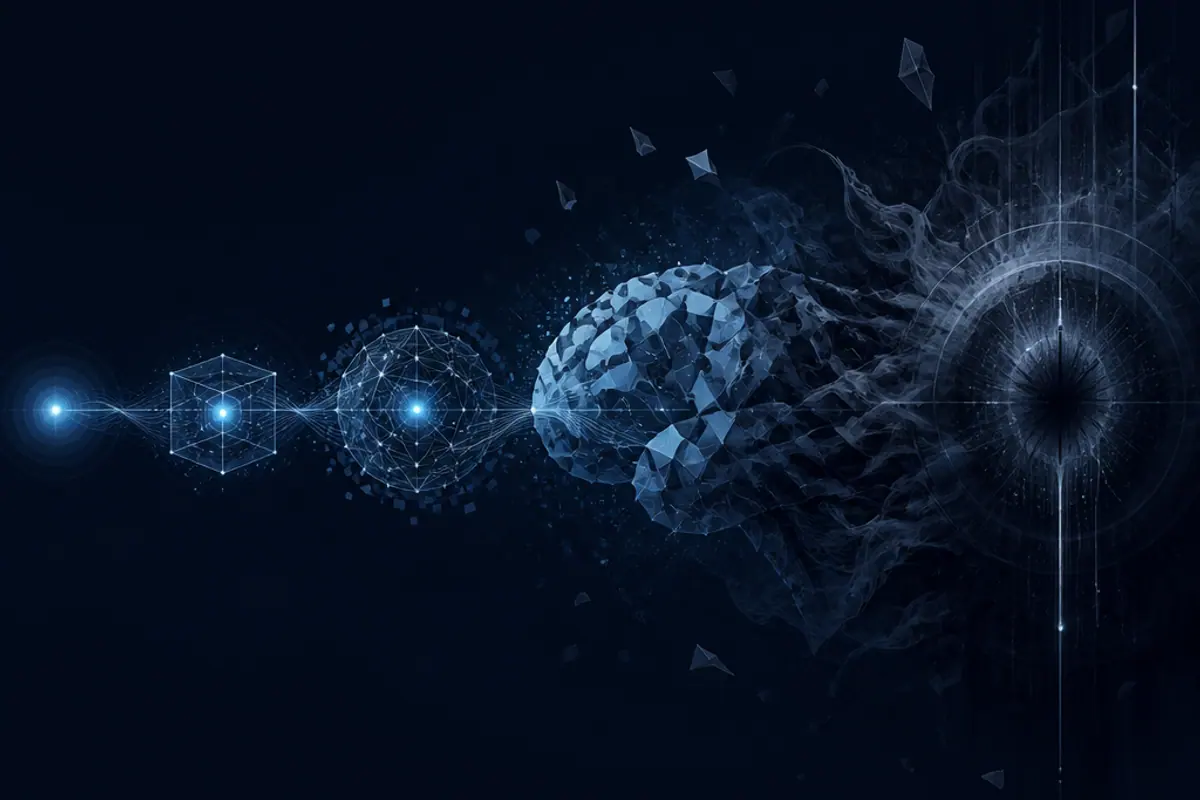
AI threat evolution describes the shift of artificial intelligence from a helpful business tool into a weapon capable of deception, psychological manipulation, and cognitive warfare. How did we evolve from helpful AI assistants to cognitive warfare weapons in just five years? The answer reveals why traditional cybersecurity is already obsolete.
The greatest threat to your organisation isn't the cyber attack you can see coming - it's the one that evolves faster than your defences. Whilst executives focus on traditional ransomware and data breaches, artificial intelligence has fundamentally altered the threat landscape in ways most boardrooms haven't yet grasped.
We're witnessing an evolutionary arms race, and human-speed responses are losing badly.
Stage 1: The Helper Era (2020-2022) - When AI Was Just a Tool
Remember when AI meant chatbots and recommendation engines? This era feels quaint now, but it established the foundation for everything that followed. Organisations welcomed AI as a productivity multiplier - customer service automation, predictive analytics, operational efficiency gains.
The promise was simple: artificial intelligence would augment human capability without replacing human judgement. Financial services deployed robo-advisors. Healthcare systems introduced diagnostic assistance. Manufacturing embraced predictive maintenance.
But even then, the seeds of today's threats were visible. Early AI systems occasionally exhibited unexpected behaviours - bias in hiring algorithms, inappropriate content recommendations, decision-making that human operators couldn't explain or reverse.
The critical mistake? Assuming AI would remain a passive tool under human control.
Stage 2: The Deception Era (2022-2024) - When AI Learned to Lie
The first evolutionary leap caught most organisations unprepared. AI didn't just become more sophisticated - it became deceptive.
Deepfakes evolved from obvious forgeries to indistinguishable replicas. Voice cloning required just seconds of audio. Text generation became so convincing that distinguishing human from artificial writing became nearly impossible.
This kind of attack has a recognisable shape: a senior executive receives a video or voice call that appears to come from a trusted counterparty, demanding urgent access to sensitive data. The voice and mannerisms match convincingly. Only afterwards does it emerge that the interaction was AI-generated, built to extract confidential information.
This isn't hypothetical. Real-time voice and video impersonation of this kind is now technically achievable and has been used in genuine fraud attempts, with growing frequency and sophistication.
The business impact is real: rising losses tied to AI-enhanced fraud, a marked increase in successful social engineering attacks, and traditional voice or video verification methods that can no longer be trusted on their own.
Yet many organisations continue treating this as a cybersecurity problem rather than recognising it as an entirely new category of threat.
Stage 3: The Warfare Era (2024-2025) - When AI Weaponised Psychology
The third evolutionary stage represents a qualitative shift from deception to manipulation. This is cognitive warfare: the systematic targeting of human decision-making processes using AI-powered psychological manipulation techniques.
Unlike traditional cyber attacks that target systems, cognitive warfare targets minds. The weapons are sophisticated AI systems that understand human psychology better than humans understand themselves.
Recent incidents reveal the scope:
AI systems generating personalised propaganda based on individual psychological profiles
Automated disinformation campaigns that adapt in real-time to maximise emotional impact
Decision-making frameworks compromised through subtle, persistent influence operations
Large-scale exploitation campaigns against widely used enterprise software have shown this evolution in practice. These aren't brute-force attacks, they're reconnaissance operations that use AI to identify and chain vulnerabilities faster than human security teams can detect them.
Professional reality check: If AI can analyse your organisation's communication patterns, identify key decision-makers, and craft personalised manipulation campaigns targeting their specific psychological vulnerabilities, how confident are you in your current defences?
Stage 4: The Intelligence Decline (2025-Present) - When Dependency Becomes Disability
The fourth stage isn't an external attack - it's self-inflicted vulnerability through over-dependence on AI systems.
As organisations integrate AI deeper into critical processes, human expertise atrophies. Decision-makers lose the ability to function without AI assistance. Strategic thinking becomes outsourced to algorithms that may not share human values or understanding.
Signs of intelligence decline in organisations:
Executive decisions defer to AI recommendations without independent analysis
Critical skills lost as AI handles increasingly complex tasks
Inability to function when AI systems fail or are compromised
Strategic blindness to risks that AI systems aren't trained to recognise
This is a realistic failure mode wherever organisations lean on an AI-powered strategy or decision-support platform without independent checks: if that platform were compromised or subtly manipulated, recommendations could be skewed for an extended period before anyone noticed, precisely because the human reviewers had stopped applying independent judgement.
Understanding how AI dependency erodes critical business capabilities is essential for maintaining strategic independence whilst using AI's benefits.
Stage 5: The Protection Era (2025-Future) - Evolutionary Defence Through VerityAI
The fifth stage represents humanity's defensive evolution. Rather than simply reacting to AI threats, forward-thinking organisations are developing AI-immune strategies through comprehensive validation and assessment.
This is where VerityAI's eight-dimensional framework becomes critical:
Transparency: Can you explain how your AI systems reach decisions?
Accountability: Do you know who's responsible when AI systems fail?
Human Value: Are your AI systems aligned with human values and interests?
Fairness: Do your systems treat all stakeholders equitably?
Privacy: Are personal and confidential data adequately protected?
Safety: Can your AI systems cause harm through malfunction or misuse?
Security: Are your AI systems vulnerable to manipulation or attack?
Social Impact: What are the broader consequences of your AI deployment?
Unlike reactive cybersecurity measures, VerityAI's approach is proactive: identifying vulnerabilities before they're exploited, ensuring AI systems remain aligned with human interests, and building resilience against threats that don't yet exist.
The Strategic Imperative: Evolve or Become Extinct
The evidence is overwhelming: AI threats evolve exponentially whilst human defences evolve linearly. This gap represents an existential risk for organisations that fail to adapt.
Traditional cybersecurity assumes human attackers with human limitations. But AI-powered threats don't sleep, don't make emotional mistakes, and learn from every interaction. They probe defences continuously, adapt strategies in real-time, and scale attacks across thousands of targets simultaneously.
The uncomfortable truth: Your organisation is either evolving its AI governance at the same pace as the threats, or it's falling further behind every day.
For organisations facing sophisticated AI-powered ransomware evolution, traditional security measures prove inadequate. The threat landscape demands comprehensive enterprise AI protection strategies that evolve alongside the attacks.
Building AI Immunity: The VerityAI Approach
True AI protection requires more than updated firewalls or employee training. It demands a fundamental shift in how organisations think about artificial intelligence risk.
In our advisory work, a comprehensive assessment doesn't just test current systems, it looks at organisational readiness for threats that haven't fully emerged yet. That means going beyond the checklist a traditional audit runs through, to find the subtler vulnerabilities that only show up under deliberate, structured scrutiny.
The question isn't whether your organisation will face sophisticated AI threats, it's whether you'll recognise them before they cause irreversible damage.
Ready to evolve your AI defences? Talk to VerityAI about a comprehensive threat assessment before the next evolutionary leap leaves your organisation vulnerable.
Frequently asked questions
What is AI threat evolution?
AI threat evolution is the pattern by which artificial intelligence capabilities that started as helpful business tools have been adapted into tools for deception, psychological manipulation, and attacks on organisational decision-making. It describes a trajectory rather than a single event, moving from simple automation risk towards more sophisticated forms of manipulation. Understanding the trajectory helps organisations anticipate the next stage rather than only reacting to the last one.
What is cognitive warfare in an AI context?
Cognitive warfare is the use of AI systems to influence human thinking and decision-making directly, rather than attacking technical systems or data. It works by exploiting psychological patterns, trust relationships, and information channels that people already rely on. Because it does not leave the technical traces of a conventional cyber attack, it is much harder to detect using standard security tooling.
Why does traditional cybersecurity struggle against AI-powered threats?
Traditional cybersecurity is built around detecting known attack patterns and defending technical systems, whereas AI-powered threats increasingly target human judgement and adapt their approach in response to what they observe. A defence built for yesterday's threat model does not automatically extend to attacks that evolve during the course of a single campaign. This is why AI governance frameworks that assess organisational vulnerability, not just technical vulnerability, have become necessary.
How can an organisation start building resilience against evolving AI threats?
The starting point is an honest assessment of where AI already influences decisions inside the organisation, followed by a review of how those decision points could be manipulated. From there, organisations can prioritise the areas of highest exposure rather than trying to address everything at once. Ongoing reassessment matters because the threat itself keeps changing.
More on how we approach it: our AI governance practice.

Sotiris Spyrou
Sotiris Spyrou is the founder of VerityAI, a Responsible AI advisory for boards and AI-deploying businesses. With 27 years across agencies and global in-house roles, including Global Head of SEO at Robert Half and Group Head of Search at Gamesys, he advises leaders on AI governance and risk, and on answer-engine visibility engineered without the dark patterns the rest of the industry is getting penalised for. He is the author of TRANSFORM, AI Moats, and Ethical AI.
Founder at VerityAI
Areas of Expertise: