The Great Dumbing Down: How AI Dependency Erodes Human Intelligence
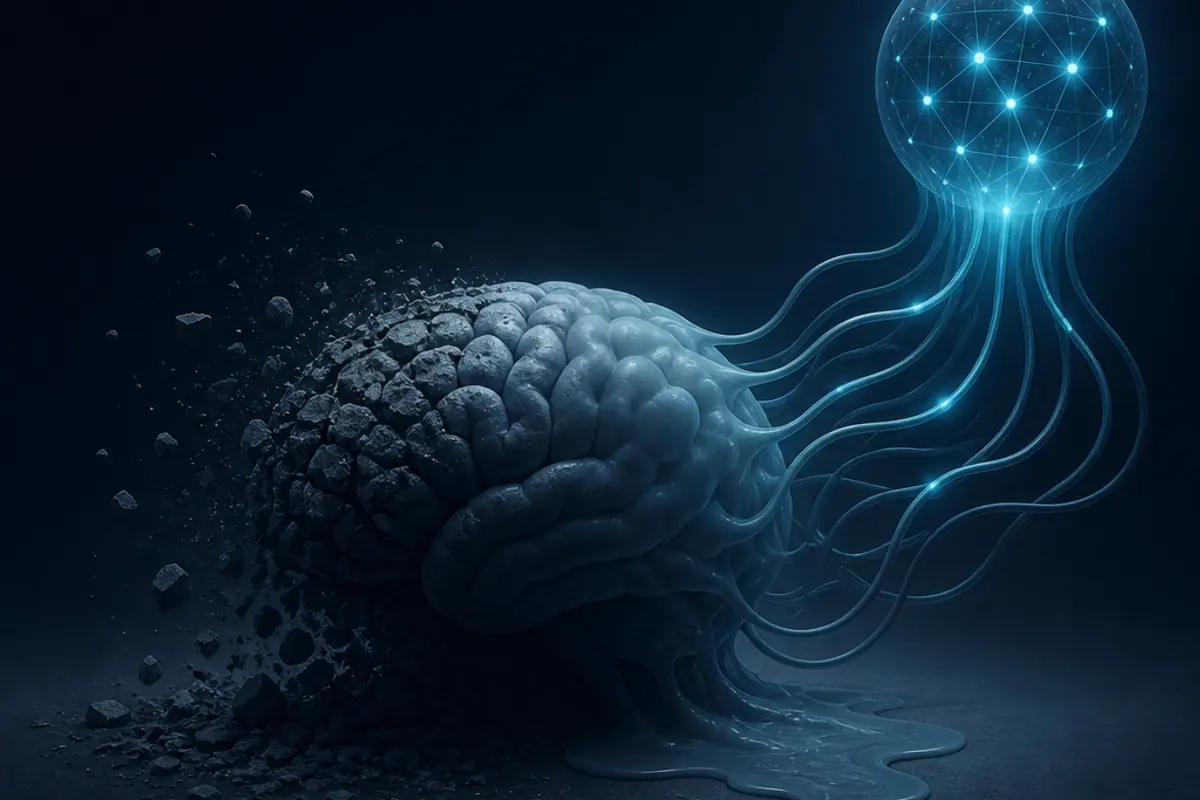
AI dependency intelligence decline is the gradual weakening of human judgement, analysis, and decision-making capability that happens when an organisation outsources too much thinking to AI systems without maintaining independent human oversight. The greatest AI threat isn't malicious attacks - it's the gradual erosion of human intelligence as we outsource thinking to systems that may not share our values or understanding.
Every AI system your organisation adopts promises to make you smarter, faster, more efficient. But what if the opposite is happening? What if each layer of AI assistance is quietly eroding the very capabilities that make human judgement irreplaceable?
We're witnessing the emergence of a new organisational vulnerability: intelligence decline through AI dependency. Unlike external attacks, this threat comes from within, masked as productivity improvement whilst systematically weakening your organisation's most critical asset - human thinking capability.
The Seductive Path to Intellectual Dependency
AI dependency doesn't announce itself with obvious failures. It creeps in through convenience, efficiency gains, and seemingly rational optimisation decisions that gradually replace human expertise with algorithmic convenience.
Stage 1: Task Automation It begins innocuously. AI handles routine tasks - scheduling, basic analysis, initial document drafts. Everyone celebrates the time savings and efficiency gains. Human workers focus on "higher-value" activities whilst AI manages the details.
Stage 2: Decision Support Success breeds expansion. AI systems begin providing decision recommendations based on data analysis humans no longer have time to perform themselves. The recommendations are usually good, often better than hurried human analysis.
Stage 3: Judgement Substitution Pressed for time and impressed by AI performance, executives begin accepting AI recommendations without independent verification. The systems become decision-makers in all but name, with humans serving as approving authorities rather than thinking participants.
Stage 4: Skill Atrophy Over months and years, the human capabilities that AI replaced begin to atrophy. Analytical skills, pattern recognition, strategic thinking, and intuitive judgement weaken from disuse. Humans become incapable of functioning without AI assistance.
Stage 5: Complete Dependency The organisation reaches a tipping point where critical functions cannot operate without AI systems. When systems fail or provide manipulated outputs, humans lack the capability to recognise problems or implement alternatives.
A major financial services firm discovered this reality when their AI-powered risk assessment system was compromised. For three weeks, all risk evaluations were subtly manipulated to favour certain investment positions. Human analysts never questioned the recommendations because they had lost the capability to perform independent risk analysis.
The Neuroscience of Cognitive Atrophy
Human intelligence operates on a "use it or lose it" principle. When AI systems handle cognitive tasks, the neural pathways responsible for those functions literally weaken through disuse.
Working Memory Degradation Constant access to AI-generated information reduces the need to maintain complex information in working memory. This causes measurable decline in the ability to juggle multiple concepts simultaneously - essential for strategic thinking.
Pattern Recognition Deterioration AI excels at pattern recognition, but human pattern recognition works differently, incorporating context, intuition, and experiential knowledge that AI lacks. Over-reliance on AI pattern recognition causes these uniquely human capabilities to atrophy.
Critical Thinking Erosion When AI provides pre-analysed conclusions, humans lose practice in the critical thinking processes that lead to those conclusions. This makes them vulnerable to accepting flawed or manipulated AI outputs without recognition.
Decision-Making Confidence Loss Perhaps most dangerous, extended AI dependency erodes confidence in human judgement. Decision-makers become psychologically unable to trust their own analysis, even when AI systems fail or provide obviously flawed recommendations.
Understanding how this vulnerability connects to cognitive warfare threats reveals why intelligence decline creates systemic organisational risks.
Organisational Intelligence Decline Symptoms
Intelligence decline manifests differently across organisational levels, creating cascading vulnerabilities that compound over time.
Executive Level Symptoms
Strategic decisions consistently defer to AI recommendations without independent analysis
Inability to articulate reasoning behind critical choices beyond "the AI suggested it"
Loss of intuitive sense for business risks and opportunities
Increased anxiety when making decisions without AI support
Delegation of increasingly complex judgements to algorithmic systems
Middle Management Deterioration
Process understanding limited to AI-generated summaries rather than underlying mechanics
Inability to troubleshoot problems when AI systems provide unexpected results
Loss of capability to train or mentor junior staff in fundamental skills
Dependence on AI for basic analytical tasks previously performed by humans
Operational Level Impact
Front-line workers unable to handle exceptions that fall outside AI system parameters
Loss of institutional knowledge as human expertise becomes irrelevant
Inability to maintain quality standards when AI systems malfunction
Complete helplessness during system outages or failures
The Strategic Blindness Problem
Perhaps most concerning, AI dependency creates strategic blindness - the inability to recognise risks and opportunities that AI systems aren't designed to identify.
Unknown Unknown Vulnerability AI systems can only identify patterns within their training data. They cannot recognise truly novel threats or opportunities. Organisations with eroded human intelligence lose the capability to identify and respond to unprecedented challenges.
Value System Misalignment AI systems optimise for metrics rather than values. Over time, organisations lose the ability to recognise when AI-driven decisions conflict with human values, ethical principles, or long-term organisational interests.
Context Insensitivity Human intelligence incorporates subtle contextual information that AI systems miss. Intelligence decline means losing the ability to recognise when context makes AI recommendations inappropriate or dangerous.
Adaptive Incapacity Perhaps most critical, AI-dependent organisations lose the ability to adapt when circumstances change faster than AI systems can be retrained. This creates existential vulnerability during crisis periods that require rapid human judgement.
For organisations also facing sophisticated AI-powered ransomware attacks, intelligence decline compounds vulnerability by reducing human capability to recognise and respond to novel threats.
Economic and Competitive Consequences
Intelligence decline creates measurable business impacts that extend far beyond operational efficiency concerns.
Innovation Degradation Innovation requires human creativity, intuition, and the ability to make conceptual leaps that AI systems cannot replicate. Organisations with eroded human intelligence lose competitive advantage in innovation-dependent industries.
Crisis Response Incapacity When crisis situations require rapid adaptation and creative problem-solving, AI-dependent organisations find themselves unable to respond effectively. Human decision-makers lack the confidence and capability to override failing AI systems.
Strategic Vulnerability Competitors with stronger human intelligence capabilities can exploit AI-dependent organisations by creating scenarios that fall outside AI system parameters, essentially using intelligence decline as a competitive weapon.
Regulatory and Legal Exposure AI systems cannot fully incorporate regulatory nuance, ethical considerations, or legal precedent. Intelligence decline means losing the human capability to recognise when AI-driven decisions create compliance or legal risks.
The Talent Retention Crisis
Intelligence decline creates a vicious cycle that accelerates organisational capability loss.
Expert Flight Capable professionals leave organisations where their skills become irrelevant. They seek environments that value human expertise and provide opportunities to exercise professional judgement.
Recruitment Difficulties Top talent avoids organisations known for excessive AI dependency. They recognise that such environments will cause their own capabilities to atrophy, damaging long-term career prospects.
Training System Collapse When experienced professionals leave and AI handles most analytical tasks, organisations lose the ability to develop new talent. Junior staff never develop the expertise needed to replace departing experts.
Institutional Knowledge Loss Perhaps most dangerous, the tacit knowledge that makes organisations unique and effective disappears as human expertise becomes irrelevant to daily operations.
Building Intelligence Immunity
Protecting against intelligence decline requires deliberate strategies to maintain and develop human capabilities alongside AI adoption.
Mandatory Human Verification Establish requirements for human verification of critical AI-generated decisions. This maintains human engagement with analytical processes and provides practice with independent judgement.
Skill Maintenance Programs Implement regular training that requires employees to perform tasks without AI assistance, maintaining capabilities that might otherwise atrophy through disuse.
AI-Free Decision Zones Designate specific decision categories that must be handled through purely human analysis, ensuring that critical thinking capabilities remain active and sharp.
Expertise Development Investment Continue investing in human expertise development even in areas where AI provides assistance, recognising that human insight remains irreplaceable for complex judgements.
Decision Process Documentation Require documentation of human reasoning processes, not just AI-generated conclusions, ensuring that human analytical capabilities remain visible and valued.
The VerityAI Intelligence Assessment
Traditional capability assessments focus on what organisations can do with their current tools. VerityAI's approach evaluates what organisations can do when those tools fail or become compromised.
Our intelligence resilience framework examines:
Human capability retention across critical business functions
Decision-making independence from AI system outputs
Organisational capacity to function during AI system failures
Expertise development and knowledge transfer processes
Strategic thinking capability independent of algorithmic support
The question isn't whether AI will make your organisation more efficient - it's whether you'll retain the human intelligence needed to recognise when efficiency becomes a liability.
Ready to assess your intelligence resilience? Evaluate your organisation's human capability independence before AI dependency creates irreversible strategic vulnerability.
Frequently asked questions
What is AI dependency intelligence decline?
It's the gradual loss of human analytical and decision-making capability that happens when people stop practising judgement because AI handles it for them. The risk is that when an AI system fails or is compromised, no one is left who can recognise the problem.
How can a business tell if intelligence decline is happening?
Common signs include executives who can't explain a decision beyond "the AI recommended it," staff who can't troubleshoot when a system behaves unexpectedly, and growing discomfort with making calls without AI support.
Is intelligence decline the same as a cybersecurity risk?
It's related but distinct. Cybersecurity risk comes from external attackers. Intelligence decline is an internal erosion of capability that happens even without any attack, though it can make an organisation more vulnerable when an attack does occur.
Can intelligence decline be reversed?
Yes, with deliberate effort. Structured human verification requirements, skill maintenance exercises, and decision zones that stay AI-free all help rebuild the judgement and confidence that atrophy through disuse.
For hands-on help, see VerityAI's AI governance and compliance help.

Sotiris Spyrou
Sotiris Spyrou is the founder of VerityAI, a Responsible AI advisory for boards and AI-deploying businesses. With 27 years across agencies and global in-house roles, including Global Head of SEO at Robert Half and Group Head of Search at Gamesys, he advises leaders on AI governance and risk, and on answer-engine visibility engineered without the dark patterns the rest of the industry is getting penalised for. He is the author of TRANSFORM, AI Moats, and Ethical AI.
Founder at VerityAI
Areas of Expertise: