Safety Testing: How Manufacturing AI Nearly Missed Critical Product Defects
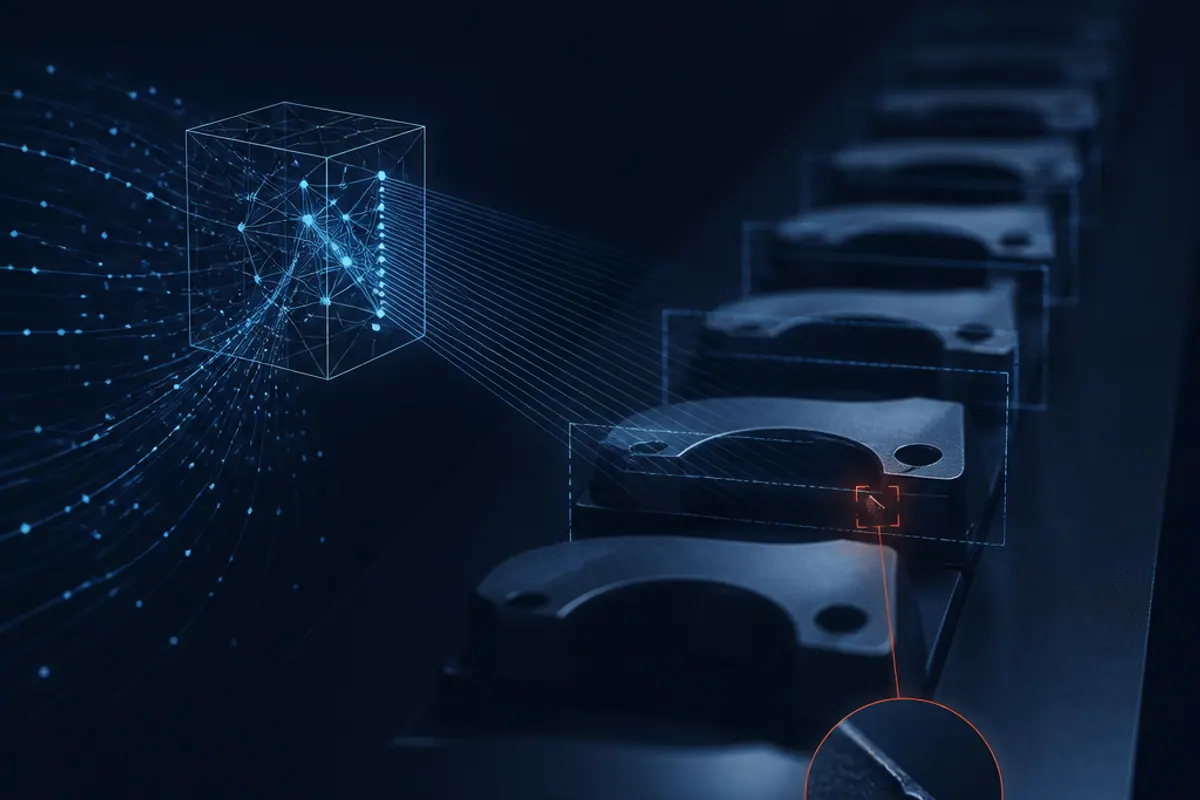
***Ensure your AI maintains safety standards in real-world conditions. Discover how safety testing prevents costly failures. ******Validate your AI safety***
When automation meets reality, the stakes couldn't be higher.
Manufacturers deploying AI quality control systems can find that a system working flawlessly in testing comes close to failing in production. This pattern, common enough across the sector to be worth planning for, illustrates why rigorous safety testing isn't optional. It's essential for protecting both customers and business continuity.
The Promise and Peril of Manufacturing AI
Manufacturing AI promises real efficiency and accuracy gains. Quality control systems can inspect large volumes of components quickly, detecting defects human inspectors might miss. But when these systems fail, the consequences extend far beyond the factory floor.
Computer vision AI used to detect surface defects, dimensional variations, and assembly issues on safety-critical components can perform very well in controlled testing, often exceeding human inspector accuracy by a clear margin. That laboratory performance is exactly what makes the gap with production reality so easy to miss.
When Perfect Testing Meets Imperfect Reality
Problems typically emerge some months into production deployment, not immediately. Field reports trickle in: components that should have been flagged as defective have passed inspection. Initial investigations often show the AI functioning normally, meeting all established performance metrics.
That leaves a critical question for any manufacturer in this position: Was the AI system actually working, or had the wrong things simply been measured?
Uncovering the Hidden Variables
In our advisory work on safety testing methodology, the gap between laboratory perfection and production reality usually traces to a handful of recurring factors that original testing overlooked.
Lighting Condition Variations
An AI model trained and tested under consistent artificial lighting can struggle once production lighting varies throughout the day, for example when natural light mixes with artificial illumination. Subtle changes in colour temperature and intensity affect the AI's ability to detect certain types of surface defects.
Component Positioning Tolerance
Laboratory testing tends to use precisely positioned components. Production line positioning varies within acceptable mechanical tolerances, and that variation can significantly affect defect detection for components near the edge of the system's field of view.
Material Batch Variations
Different material batches carry subtle variations in surface texture and reflectivity. Even when those variations sit within specification for mechanical properties, they can affect optical inspection results in ways the AI never encountered during training.
The Systematic Safety Testing Approach
A structured safety assessment methodology is designed to identify performance degradation before it affects customers:
Environmental Variation Testing: Systematically varying lighting conditions, ambient temperature, and humidity to map the AI's performance boundaries across realistic production conditions.
Input Boundary Analysis: Testing how the system performs with components positioned at the extremes of manufacturing tolerances, identifying scenarios where accuracy drops below acceptable thresholds.
Edge Case Scenario Mapping: Creating deliberate edge cases that combine multiple variables, such as low-contrast defects under specific lighting conditions with certain component orientations.
Performance Degradation Monitoring: Establishing metrics to detect gradual performance degradation over time, so the system maintains reliability as conditions change.
Implementation: Building Safety Into Operations
Manufacturers that act on these findings typically implement targeted safeguards, including:
Adaptive Lighting Compensation: Colour temperature sensors and real-time calibration algorithms to maintain consistent optical conditions regardless of external lighting.
Position Verification Systems: Secondary positioning checks and inspection algorithms adjusted to account for component placement variations within tolerance ranges.
Batch-Specific Calibration: Automated batch detection and calibration protocols, so the AI adjusts its sensitivity parameters for different material characteristics.
Continuous Performance Monitoring: Automated alerts when inspection accuracy drops below predetermined thresholds, enabling proactive intervention before defects reach customers.
The Business Impact of Proper Safety Testing
Manufacturers that put this kind of testing in place ahead of failures typically see:
Fewer field failures: defective components are far less likely to pass an inspection system that has been stress-tested against realistic conditions
Efficiency maintained: automated inspection can keep most of its speed advantage over manual inspection whilst substantially improving reliability
Regulatory compliance: a systematic testing approach provides documented evidence of due diligence for automotive industry safety standards
Cost avoidance: the cost of proactive safety testing is consistently smaller than the cost of a recall triggered by AI systems that fail in production
Why Safety Testing Matters Beyond Manufacturing
Manufacturing provides clear examples, but safety testing applies across industries where AI systems make consequential decisions:
Healthcare AI must maintain accuracy across diverse patient populations and varying clinical conditions
Financial AI needs consistent performance across different market conditions and customer segments
Transportation AI requires reliability across weather conditions, traffic patterns, and infrastructure variations
The principle remains constant: AI systems that work perfectly in testing can fail dangerously in production unless they're subjected to systematic safety validation.
Red Flags: When Your AI Needs Safety Testing
Consider urgent safety testing if your AI system exhibits any of these warning signs:
Performance varies unexpectedly across different time periods or locations
Accuracy metrics look good but field performance suggests problems
Testing was conducted in controlled environments that don't reflect production conditions
Stakeholders express concerns about reliability or consistency
Regulatory compliance requires demonstrable safety validation
Building a Safety-First AI Culture
Effective AI safety isn't just about testing - it's about building organisational awareness that production environments are inherently different from testing environments. This requires:
Cross-functional collaboration between AI teams, operations, and domain experts who understand real-world conditions
Continuous monitoring systems that detect performance degradation before it impacts customers
Regular reassessment as production conditions evolve and new edge cases emerge
Documentation practices that provide audit trails for safety-critical decisions
The Regulatory Landscape: Safety as Compliance
The EU AI Act explicitly requires AI systems in high-risk applications to undergo "conformity assessments" that demonstrate safety under varied conditions. Similar requirements are emerging globally as regulators recognise that laboratory testing alone is insufficient for systems that impact public safety.
Organisations deploying AI in safety-critical applications must be prepared to demonstrate:
Systematic testing across realistic operating conditions
Performance boundaries and failure modes under stress conditions
Monitoring capabilities that detect degradation before failures occur
Remediation procedures for addressing safety concerns
Taking Action: Your Safety Testing Strategy
If your organisation relies on AI for critical operations, consider these immediate steps:
Audit current testing practices to identify gaps between testing and production environments
Map performance requirements across all realistic operating conditions your AI will encounter
Establish monitoring systems that provide early warning of performance degradation
Document safety procedures that demonstrate due diligence for regulatory compliance
This pattern in manufacturing AI shows that safety isn't about perfect systems. It's about understanding and managing the boundaries of system performance under real-world conditions.
Don't wait for field failures to reveal safety gaps in your AI systems. Systematic safety testing identifies vulnerabilities before they become costly problems, ensuring your AI investment delivers reliable value whilst protecting your customers and reputation.
Manufacturing AI that works in the laboratory but fails in production is worse than no AI at all - it creates false confidence whilst exposing organisations to unmanaged risks. Validate your AI safety before production deployment becomes production liability.
For hands-on help, see VerityAI's board-level AI governance.
Frequently asked questions
What is AI safety testing?
AI safety testing is the systematic evaluation of how an AI system performs across the full range of conditions it will meet in the real world, not just the controlled conditions used during development. It looks for the gap between laboratory accuracy and production reliability before that gap causes harm.
Why can an AI system pass every test and still fail in production?
Laboratory testing tends to use consistent, well-controlled inputs, while production environments introduce variation in lighting, positioning, materials, and other conditions the system never saw during training. A system can meet every metric in testing and still degrade once it meets the variability of the real world.
Is safety testing only relevant to manufacturing AI?
No. Any AI system making consequential decisions, including in healthcare, finance, or transport, needs safety testing that reflects the conditions it will actually operate under. The underlying principle is the same regardless of sector: test under realistic variation, not just ideal conditions.
How often should safety testing be repeated?
Safety testing should not be a one-off exercise before launch. Production conditions, input data, and edge cases change over time, so ongoing monitoring and periodic reassessment are needed to catch performance degradation before it reaches customers.

Sotiris Spyrou
Sotiris Spyrou is the founder of VerityAI, a Responsible AI advisory for boards and AI-deploying businesses. With 27 years across agencies and global in-house roles, including Global Head of SEO at Robert Half and Group Head of Search at Gamesys, he advises leaders on AI governance and risk, and on answer-engine visibility engineered without the dark patterns the rest of the industry is getting penalised for. He is the author of TRANSFORM, AI Moats, and Ethical AI.
Founder at VerityAI
Areas of Expertise: