The Algorithm Ate My Job (And Yours Is Next)
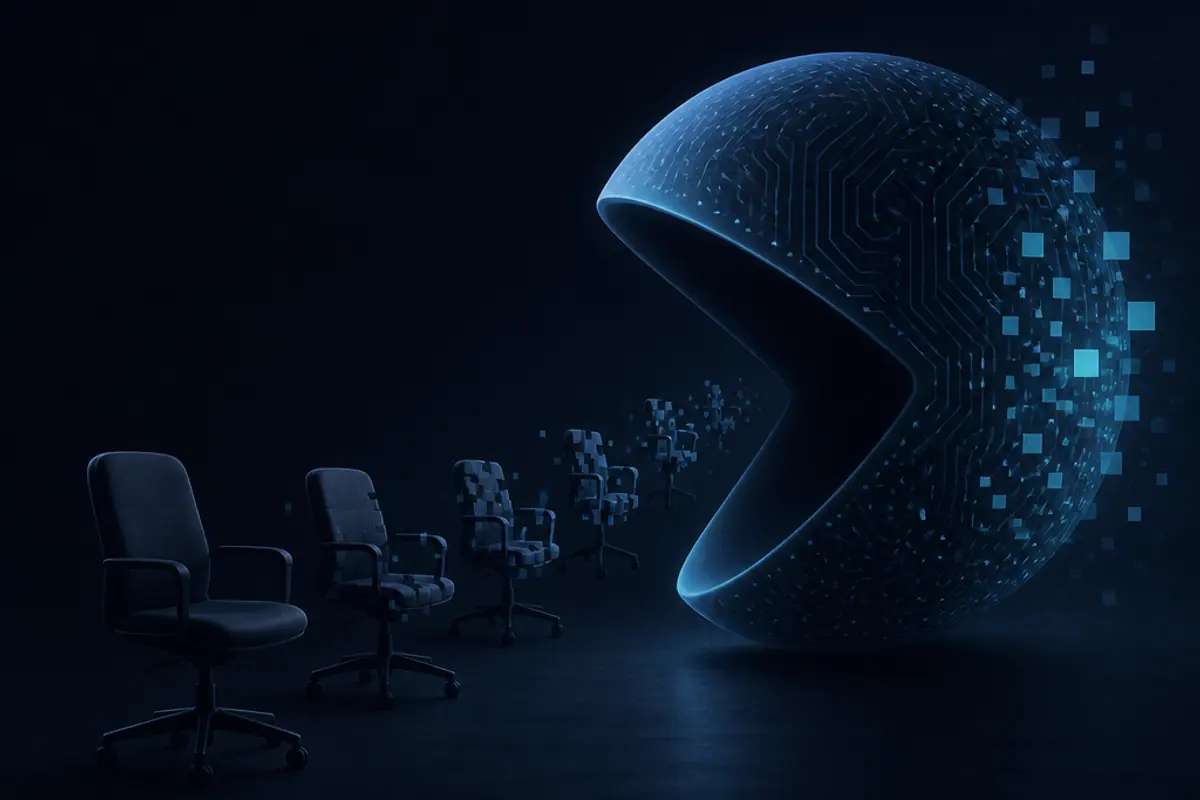
Algorithmic job displacement is the process by which AI systems take over tasks and decisions once reserved for skilled human roles, moving steadily up the value chain from manual labour to analysis, strategy, and now executive judgment. We automated factory workers, then call centre staff, then drivers. Now algorithms are coming for strategists, analysts, and yes - even CEOs. The question isn't whether AI will take your job. It's whether you'll have any say in how.
First, they automated the assembly line workers.* "Don't worry,"* they said, "automation only replaces routine manual labour. Knowledge work is safe."
Then they automated the call centre staff. "Don't worry," they said, "AI only handles simple customer queries. Complex problem-solving is safe."
Then they automated the drivers. "Don't worry," they said, "autonomous vehicles only work in controlled environments. Strategic thinking is safe."
Now they're automating the analysts, the writers, the designers, and the strategists. And they've stopped pretending anyone is safe.
The algorithmic appetite is infinite. Every job that can be reduced to patterns and decisions is potential food for the machine learning grinder.
The Hierarchy of Algorithmic Hunger
AI doesn't just eat jobs randomly - it follows a predictable pattern, moving up the economic value chain:
Level 1: Manual labour (1990s-2000s) Factory workers, assembly line operators, warehouse staff. Physical tasks that could be standardised and mechanised.
Level 2: Data processing (2000s-2010s) Bank tellers, data entry clerks, basic bookkeeping. Routine information handling that could be digitised and automated.
Level 3: Customer interface (2010s-2020s) Call centre agents, basic technical support, simple sales roles. Scripted interactions that could be handled by increasingly sophisticated chatbots.
Level 4: Analysis and creation (2020s-present) Junior analysts, content writers, graphic designers, basic legal research. Pattern recognition and content generation that AI now handles competently.
Level 5: Strategy and judgment (2020s-future) Management consultants, investment analysts, strategic planners, middle management. Complex decision-making that AI is beginning to challenge.
Level 6: Executive leadership (future) C-suite decision-making, board oversight, strategic vision. The final frontier that algorithms are starting to probe.
Each level thought it was immune to automation. Each level was wrong.
The C-Suite Delusion
Senior executives watch AI eliminate junior roles and assume their positions are secure. They're making the same mistake as factory workers in the 1990s, call centre managers in the 2000s, and mid-level analysts today.
"My job requires human judgment, strategic thinking, and leadership. AI can't replace that."
This is exactly what every displaced worker has said before their displacement. The difference is only timing and sophistication.
Consider what modern AI can already do:
Analyse complex datasets faster than any human analyst
Generate strategic recommendations based on market trends and competitive intelligence
Conduct scenario planning across thousands of variables simultaneously
Identify patterns in customer behaviour that escape human observation
Optimise resource allocation across complex organisational structures
AI isn't just coming for routine decision-making - it's targeting the core functions that justify executive compensation.
The McKinsey Moment
Management consulting - the pinnacle of strategic thinking and business judgment - is already being hollowed out by AI.
Junior consultants who once spent months building financial models now compete with AI that generates the same analysis in hours.
Senior consultants who built careers on pattern recognition and best practice application watch AI identify similar patterns across vastly larger datasets.
McKinsey, BCG, and Bain aren't immune. They're automating their own core competencies while charging clients premium rates for insights that AI can now generate.
The consulting industry's response: Rebrand AI-assisted analysis as "human-AI collaboration" while quietly reducing headcount and increasing margins. Classic disruption pattern - quality maintained, human involvement reduced, profits concentrated.
The Boardroom Algorithm
The final target isn't middle management - it's the C-suite itself.
CEO functions that AI can already perform:
Strategic analysis: Processing market data, competitive intelligence, and trend analysis faster and more comprehensively than human executives
Resource allocation: Optimising budgets, staffing, and investments across complex variables
Risk assessment: Identifying potential threats and opportunities across vast data landscapes
Performance monitoring: Tracking organisational metrics and identifying intervention points in real-time
Stakeholder communication: Generating reports, presentations, and strategic communications
What's left for human CEOs? Increasingly, just the ceremonial functions - being the human face for decisions that algorithms could make more efficiently.
As we explored in our analysis of AI dependency, executives are already becoming passengers in their own businesses, deferring decisions to algorithmic recommendations they don't fully understand.
The Pension Fund Precedent
Pension funds already use algorithmic trading systems that make investment decisions worth billions without human intervention. Fund managers have become system operators rather than decision-makers.
High-frequency trading eliminated most human traders. The few remaining humans monitor systems that execute thousands of trades per second based on algorithmic analysis.
Hedge funds increasingly rely on quantitative strategies that require minimal human input beyond system maintenance and parameter adjustment.
The financial industry demonstrates how quickly AI can capture even the most sophisticated decision-making roles. If algorithms can manage trillion-dollar portfolios, why not trillion-dollar companies?
The Accountability Gap
Here's the uncomfortable question: If AI makes better strategic decisions than human executives, why do we need human executives?
Traditional justifications for executive roles:
Better decision-making: AI often demonstrates superior analytical capabilities
Accountability: Algorithms can't be held personally responsible for decisions
Leadership and inspiration: Increasingly handled by communications teams and AI-generated content
Stakeholder relationships: Often managed through systems and structured processes
Vision and creativity: AI demonstrates growing capability in strategic innovation
The accountability argument is the last refuge. Humans remain necessary because someone needs to be responsible when things go wrong. But this reduces executives to very expensive liability insurance for algorithmic decision-making.
The Transition Pattern
How executive displacement actually happens:
Phase 1: AI assistance. Executives use AI for analysis and recommendations while maintaining decision-making authority. Productivity increases, confidence grows.
Phase 2: AI reliance. Executives become dependent on AI recommendations. Independent judgment atrophies. The wisdom drain effect accelerates.
Phase 3: AI validation. Executives primarily validate AI decisions rather than making independent choices. Human input becomes rubber-stamping.
Phase 4: AI autonomy. Systems make decisions automatically with human oversight. Executives monitor rather than manage.
Phase 5: AI replacement. Boards question why they're paying executive salaries for monitoring roles that lower-paid operators could perform.
Most executives are currently in Phase 2, moving rapidly toward Phase 3.
The Democratic Paradox
The cruelest irony: The executives overseeing AI implementation are automating their own jobs while believing they're immune to automation.
Every efficiency gain they achieve through AI reduces the justification for their own role. Every process they automate demonstrates that human judgment isn't necessary for that function. Every successful AI implementation proves that machines can handle another piece of executive responsibility.
They're building the case for their own obsolescence while celebrating their strategic brilliance.
The Human Premium
In a world where algorithms can outperform humans at analysis, planning, and even creativity, what value do humans provide?
The emerging human premium:
Moral judgment: Making decisions based on values rather than optimisation
Empathy and emotional intelligence: Understanding human needs beyond data patterns
Creative vision: Generating truly novel approaches rather than optimising existing patterns
Accountability: Taking personal responsibility for decisions and their consequences
Adaptability: Responding to unprecedented situations that fall outside training data
But these qualities are only valuable if organisations choose to value them over pure efficiency.
The Choice Before Leadership
Boards and shareholders face a fundamental question: Do we want human leaders who cost more and decide slower, or algorithmic systems that optimise efficiently and scale infinitely?
The economic answer is obvious. If AI can make better strategic decisions at lower cost, shareholder value maximisation demands AI leadership.
The human answer is more complex. Do we want organisations that serve human flourishing, or do we want optimal resource allocation systems that happen to employ humans?
Preparing for Algorithmic Succession
Smart executives aren't denying the possibility of AI replacement - they're preparing for it:
Developing uniquely human capabilities that complement rather than compete with AI analysis. Focusing on moral leadership, human development, and values-based decision-making.
Building AI literacy to understand the systems that may replace them. If you're going to be replaced by an algorithm, at least understand how it works.
Creating human-centred value propositions that justify continued human leadership. Demonstrating that some decisions require human judgment even when AI analysis is superior.
Investing in relationships and trust that algorithmic systems can't replicate. Building social capital that has value beyond analytical capability.
Advocating for governance structures that require human oversight and accountability, even when AI could perform the functions more efficiently.
The Final Algorithm
The algorithm is coming for every job, including yours. The question isn't whether you'll be replaced - it's whether you'll have any say in how that replacement happens.
You can deny the threat and hope you're somehow immune. You can pretend that your job requires uniquely human capabilities that AI will never master. You can assume that the pattern that has consumed every other category of work will somehow stop before reaching you.
Or you can acknowledge the reality and prepare for it.
The algorithm ate the factory worker's job. Then the call centre agent's. Then the driver's. Then the analyst's. Now it's coming for yours.
The only question left is whether you'll help design your replacement, or be surprised by it.
Don't let AI automation catch your organisation unprepared. Prepare your leadership team for the AI transition with strategic guidance from VerityAI, building human-AI collaboration that preserves essential human judgment while using algorithmic efficiency well.
Frequently asked questions
What is algorithmic job displacement?
Algorithmic job displacement is the replacement of human roles and decisions by AI systems, moving progressively from manual and routine work into analysis, strategy, and executive functions. It differs from earlier waves of automation in that it now reaches judgment-based roles once assumed to be safe. The pattern is the same each time: a role is assumed immune, then AI proves competent at its core tasks.
Which roles are most exposed to AI displacement?
Roles built around pattern recognition, data analysis, and repeatable decision-making are the most exposed, because these are the tasks AI systems handle well. This includes junior analytical and creative roles today, and increasingly extends into strategic and management functions. Roles that depend on moral judgment, accountability, and relationship-building remain comparatively more resistant, for now.
Can executives protect their roles from AI displacement?
No role is guaranteed immune, but executives can strengthen their position by focusing on what AI cannot easily replicate: moral judgment, accountability for outcomes, and building trust with people. Understanding how the AI systems in their organisation actually work, rather than simply deferring to their output, also helps preserve meaningful human oversight. Preparation matters more than denial.
Does AI displacement mean human oversight becomes pointless?
Not necessarily, but it does mean human oversight has to be deliberately designed rather than assumed. If people are only there to rubber-stamp AI recommendations without genuine independent judgment, that oversight is hollow. Meaningful oversight requires governance structures that keep a human genuinely accountable and capable of overriding the system.
For hands-on help, see VerityAI's AI compliance and risk review.

Sotiris Spyrou
Sotiris Spyrou is the founder of VerityAI, a Responsible AI advisory for boards and AI-deploying businesses. With 27 years across agencies and global in-house roles, including Global Head of SEO at Robert Half and Group Head of Search at Gamesys, he advises leaders on AI governance and risk, and on answer-engine visibility engineered without the dark patterns the rest of the industry is getting penalised for. He is the author of TRANSFORM, AI Moats, and Ethical AI.
Founder at VerityAI
Areas of Expertise: