The Devil Makes Work for Idle Hands—But First, He Makes Idle Hands
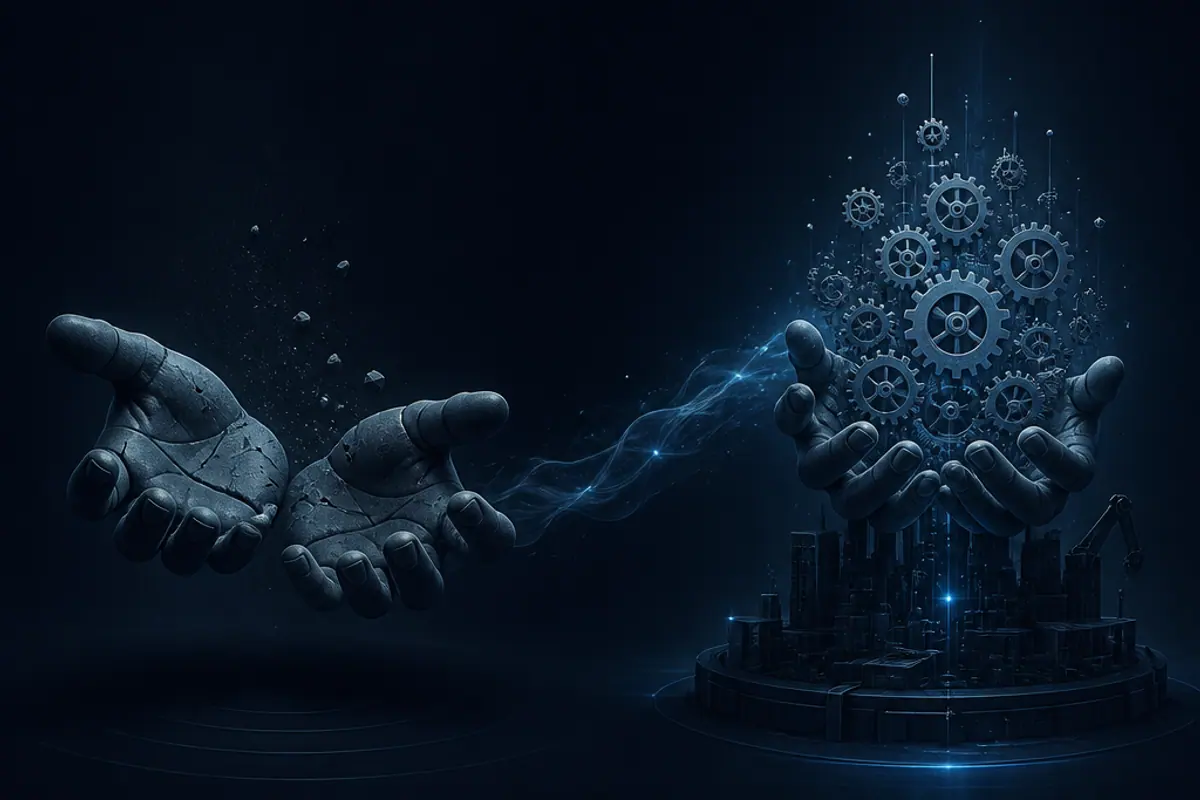
AI automation dependency is the gradual loss of a team's ability to make judgement calls without algorithmic assistance, so that when the system goes down or meets a situation it wasn't built for, nobody remembers how to decide. There's an old saying that idle hands are the devil's workshop. But we've got it backwards. The real danger isn't what people do when they're idle - it's how we're systematically making them idle in the first place.
Every day, another executive proudly announces they've "automated away" human decision-making. Customer service queries? Automated. Hiring decisions? Automated. Strategic analysis? Automated. Risk assessment? Automated. They celebrate efficiency gains while quietly creating something far more dangerous: a workforce that's forgotten how to think.
We've automated away human judgment, then wondered why our systems lack wisdom. The real AI risk isn't machines becoming too smart - it's humans becoming too dependent.
The Dependency Trap
When GPS navigation launched, we thought we'd gained convenience. What we actually lost was our sense of direction. Studies show that heavy GPS users develop measurably worse spatial awareness, struggling to navigate even familiar routes without technological assistance. We traded capability for convenience, and now we're geographically helpless.
But that's nothing compared to what we're doing with business judgment.
Consider the modern marketing executive who can't write copy without AI assistance, the analyst who panics when their dashboard goes down, or the CEO who defers every strategic decision to "what the algorithm recommends." We're not just automating tasks - we're atrophying the cognitive muscles that built successful businesses in the first place.
The most successful companies of the next decade won't be those with the most automation. They'll be those with humans who still know how to think.
When Algorithms Replace Intuition
Here's what happens when organisations automate human judgment:
First, efficiency improves. Tasks get completed faster, errors decrease, and leaders congratulate themselves on their technological sophistication. The quarterly reports look fantastic.
Then, dependency sets in. Teams stop questioning AI recommendations. "The algorithm says..." becomes the answer to every challenge. Human intuition - that messy, unreliable, but occasionally brilliant capacity for insight - gets filed away as obsolete.
Finally, crisis hits. A market shift the algorithm wasn't trained for. A customer need that doesn't fit the predictive model. A competitive threat that falls outside historical patterns. Suddenly, the organisation discovers its humans have become passengers in their own business.
When the algorithm fails, there's nobody left who remembers how to drive.
The Hidden Cost of Computational Comfort
We're witnessing the emergence of what researchers call "algorithmic learned helplessness" - the gradual erosion of human confidence in making decisions without technological assistance. It starts innocently enough: why memorise facts when Google exists? Why develop writing skills when ChatGPT can draft emails? Why cultivate business intuition when predictive analytics provide recommendations?
Each automation makes logical sense in isolation. The problem is the cumulative effect.
The pattern we see: buying and planning teams that lean on AI recommendation systems for every call can lose the ability to make independent judgements about what customers want. When the system goes offline, even briefly, the gap shows up fast, not because the AI was brilliant, but because the humans had stopped practising the judgement it replaced.
The devil didn't give them busy work to do. He made their hands idle first.
The Wisdom Recession
Business schools teach decision-making frameworks, but they don't teach decision-making courage. They focus on optimising choices rather than developing the confidence to make them. The result is a generation of leaders who are technically sophisticated but cognitively dependent.
We're already experiencing a wisdom recession - an economy where information is abundant but judgment is scarce. Where data is infinite but insight is rare. Where we can automate analysis but struggle to automate understanding.
This isn't about being anti-technology. It's about recognising that automation without human development creates fragile systems run by diminished people.
The False Choice
Silicon Valley presents automation as inevitable: "Adapt or die. Automate or become irrelevant." But this is a false choice. The real question isn't whether to use AI - it's how to use it without losing ourselves in the process.
The most dangerous companies are those that automate everything without maintaining human capability as a backup. They're building houses of cards, where a single algorithmic failure can topple the entire organisation.
The smartest companies are doing something different: they're using AI to enhance human judgment, not replace it. They're automating routine tasks while deliberately preserving and developing human decision-making capabilities. They understand that efficiency without wisdom is just elaborate stupidity.
Maintaining Human Agency in an Automated World
So how do successful organisations prevent algorithmic learned helplessness?
First, they maintain manual overrides. Not just technical kill switches, but regular exercises where humans make decisions without algorithmic assistance. They practise decision-making like a skill that can atrophy.
Second, they cultivate institutional memory. They document not just what decisions were made, but why they were made and how human judgment factored into the process. They preserve the reasoning behind the automation.
Third, they invest in human development alongside technological development. For every pound spent on AI capabilities, they spend proportionally on developing human judgment, creativity, and wisdom.
Fourth, they question their automation regularly. They ask not just "Is this efficient?" but "What are we losing by doing this automatically?"
The Strategic Advantage of Human Judgment
Here's what the pure automation advocates miss: human judgment isn't a bug to be eliminated - it's a feature to be preserved. The messy, unpredictable, occasionally irrational nature of human decision-making isn't inefficiency. It's adaptability.
When markets shift unexpectedly, when customer needs evolve beyond historical patterns, when black swan events disrupt predictive models, the organisations that survive are those with humans who still remember how to think independently.
The companies that will dominate the next decade aren't building better algorithms - they're building better humans who know how to work with algorithms.
The Choice Ahead
We stand at a crossroads. Down one path lies total automation: efficient, predictable, and ultimately fragile systems run by people who've forgotten how to function without technological assistance. Down the other lies thoughtful integration: humans and machines working together, each preserving their unique strengths.
The devil doesn't need to give idle hands busy work. He just needs to make sure they stay idle long enough to forget what work looks like.
The question every leader must ask: Are we building systems that make our people more capable, or just more dependent?
The answer will determine whether your organisation thrives in uncertainty or collapses the moment the algorithm goes quiet.
Because sooner or later, every algorithm goes quiet. And when it does, you'll discover whether you've built a business or just an elaborate automation that forgot it needed humans to survive.
The devil's greatest trick isn't convincing us he doesn't exist. It's convincing us we don't need to exist either.
Don't let automation make your organisation helpless. In our advisory work, we help organisations build AI systems that enhance rather than replace critical human judgment, preserving wisdom alongside efficiency.
More on how we approach it: board-level AI governance.
Frequently asked questions
What is AI automation dependency?
AI automation dependency is what happens when a team relies so heavily on algorithmic recommendations that its own judgement quietly atrophies. The task still gets done day to day, but the human ability to do it without the tool has faded.
How can you tell if a team has become too dependent on AI?
A common sign is what happens when the system goes offline or produces a recommendation outside its normal range: a team with intact judgement adapts, while a dependent team stalls. Watch for staff describing a tool's output as the answer rather than one input to their own decision.
Can AI automation dependency be reversed?
Yes, though it takes deliberate effort. Organisations rebuild capability by keeping manual decision-making exercises alive, documenting the reasoning behind decisions rather than just the outcome, and treating human judgement as a skill worth maintaining alongside the technology.
Does avoiding automation dependency mean using less AI?
Not necessarily. It means using AI to support human judgement rather than substitute for it entirely, and keeping people practised enough that they could step in if the system failed or hit an edge case it wasn't designed for.

Sotiris Spyrou
Sotiris Spyrou is the founder of VerityAI, a Responsible AI advisory for boards and AI-deploying businesses. With 27 years across agencies and global in-house roles, including Global Head of SEO at Robert Half and Group Head of Search at Gamesys, he advises leaders on AI governance and risk, and on answer-engine visibility engineered without the dark patterns the rest of the industry is getting penalised for. He is the author of TRANSFORM, AI Moats, and Ethical AI.
Founder at VerityAI
Areas of Expertise: