Data Centre Energy Consumption: The Hidden AI Security Risk
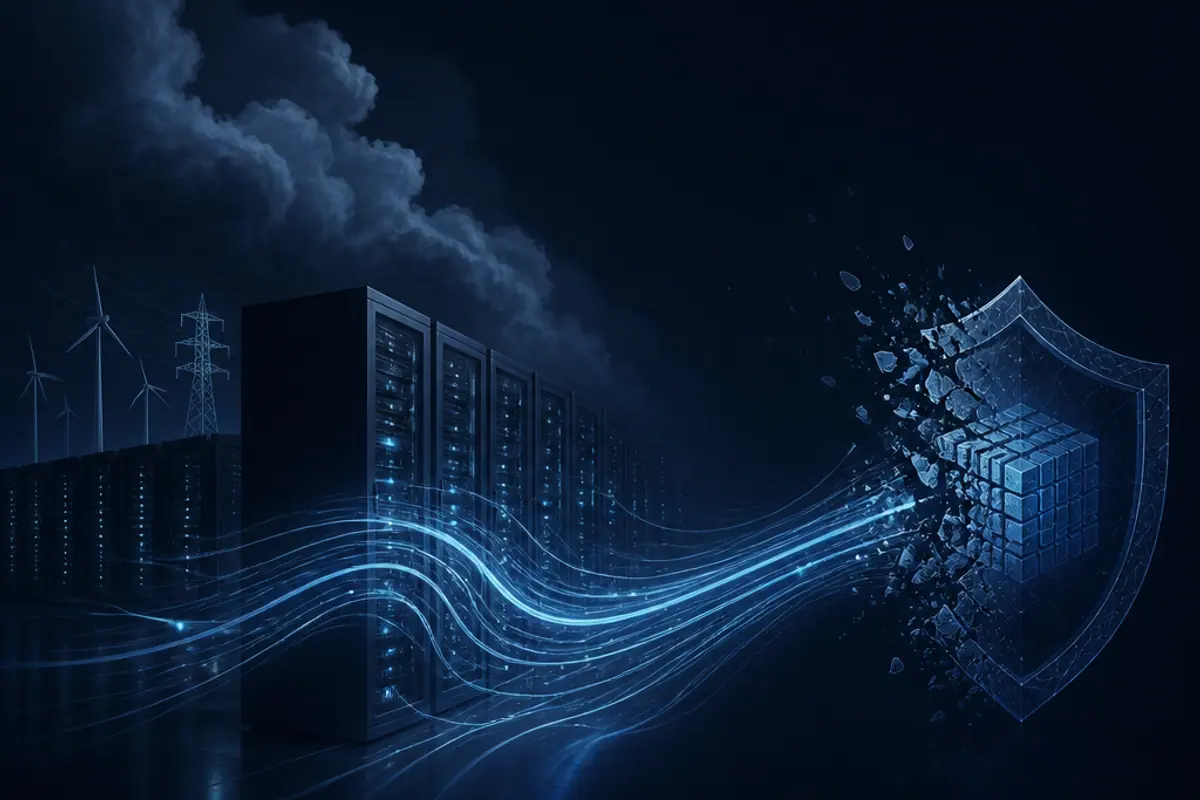
The Hidden Cost of AI Intelligence
Data centre energy consumption is an AI security risk because the power and cooling infrastructure that keeps AI systems running creates dependencies and physical attack surfaces that traditional cybersecurity controls don't cover. The artificial intelligence revolution comes with an often-overlooked security implication: massive energy consumption that creates entirely new categories of vulnerabilities. While organizations focus on protecting AI systems from data breaches and adversarial attacks, few have considered how the enormous energy requirements of AI systems create security risks that could be more devastating than traditional cyber threats.
Recent intelligence from a Bank of England cybersecurity expert highlighted this concern: "the amount of energy consumed by data centres" was identified as a significant security consideration that most organizations haven't adequately addressed. This observation reveals a critical gap in AI security thinking - the physical infrastructure that powers AI systems creates attack surfaces that traditional cybersecurity approaches cannot protect.
According to the International Energy Agency, data centres already consume approximately 1% of global electricity, with AI workloads representing the fastest-growing segment. A single large language model training run can consume as much electricity as hundreds of homes use in a year. This massive energy consumption isn't just an environmental concern - it's a security vulnerability that creates new attack vectors and systemic risks.
The Scale of AI Energy Consumption
Understanding the security implications requires grasping the scale of AI energy consumption:
Training Phase Energy Requirements
AI model training consumes enormous amounts of energy:
Large Language Models: Training GPT-3 reportedly consumed 1,287 MWh of electricity, equivalent to the annual consumption of 120 average homes.
Computer Vision Models: Training large computer vision models can consume similar amounts of energy.
Specialized Models: Domain-specific AI models often require multiple training runs, multiplying energy consumption.
Continuous Training: Many AI systems require continuous retraining, creating ongoing energy demands.
Inference Phase Energy Requirements
AI model inference also creates significant energy demands:
Real-Time Processing: AI systems providing real-time responses consume energy continuously.
Scale of Operations: Large-scale AI deployments multiply individual inference energy requirements.
Hardware Acceleration: Specialized AI hardware consumes significant power for optimal performance.
Cooling Requirements: AI hardware generates heat requiring additional energy for cooling.
Infrastructure Energy Requirements
Supporting AI infrastructure adds additional energy demands:
Data Storage: Storing training data and model parameters requires energy-intensive storage systems.
Network Infrastructure: High-bandwidth network connections for AI workloads consume additional energy.
Backup Systems: Redundant systems and backups multiply energy requirements.
Security Systems: Physical and cyber security systems add to overall energy consumption.
Security Vulnerabilities from Energy Dependency
The massive energy requirements of AI systems create several categories of security vulnerabilities:
Power Grid Dependencies
AI systems create critical dependencies on power grid infrastructure:
Single Points of Failure: Dependence on specific power grid connections creates vulnerability to power outages.
Grid Stability Risks: Large AI workloads can strain local power grids, creating instability.
Cascading Failures: Power failures can cascade through interconnected AI systems.
Geographic Concentration: Concentration of AI workloads in specific regions creates systemic risks.
Supply Chain Vulnerabilities
Energy dependencies create complex supply chain vulnerabilities:
Energy Provider Risks: Dependence on specific energy providers creates vendor lock-in risks.
Fuel Supply Risks: For backup generators, fuel supply chains create additional vulnerabilities.
Equipment Dependencies: Specialized power equipment creates supply chain concentration risks.
Maintenance Dependencies: Dependence on specialized maintenance services creates operational risks.
Physical Infrastructure Risks
Energy-intensive AI systems require physical infrastructure that can be targeted:
Cooling System Attacks: Attacks on cooling systems can cause AI hardware failures.
Power Distribution Attacks: Attacks on power distribution systems can disable AI operations.
Physical Access: Energy infrastructure may be more accessible to physical attacks than AI systems themselves.
Environmental Factors: Energy infrastructure is vulnerable to environmental factors and natural disasters.
New Attack Vectors
As per the UK government's research and analysis on cyber security risks to artificial intelligence, the energy dependency of AI systems creates entirely new attack vectors:
Resource Exhaustion Attacks
Attackers can target AI systems through resource exhaustion:
Computational Overload: Attacks designed to maximize AI computational requirements.
Energy Consumption Attacks: Attacks specifically designed to increase energy consumption.
Cost Amplification: Attacks that make AI operations economically unsustainable.
Capacity Saturation: Attacks that saturate available computational capacity.
Economic Warfare
Energy costs create opportunities for economic attacks:
Market Manipulation: Manipulating energy markets to increase AI operational costs.
Price Volatility: Exploiting energy price volatility to disrupt AI operations.
Cost Arbitrage: Using cost differences to gain competitive advantages.
Resource Competition: Creating artificial scarcity in energy resources.
Infrastructure Targeting
Energy infrastructure becomes a target for AI system disruption:
Power Grid Attacks: Attacking power grids to disrupt AI operations.
Cooling System Disruption: Disrupting cooling systems to cause hardware failures.
Physical Infrastructure: Physical attacks on energy infrastructure.
Supply Chain Disruption: Disrupting energy supply chains to affect AI operations.
Sustainability Attacks
Environmental concerns create new attack vectors:
Regulatory Pressure: Using environmental regulations to constrain AI operations.
Public Opinion: Leveraging public opinion about environmental impact to pressure organizations.
Sustainability Standards: Using sustainability standards to limit AI deployment.
Carbon Credit Manipulation: Manipulating carbon credit markets to increase AI costs.
Geopolitical Implications
The energy intensity of AI systems creates geopolitical security considerations:
National Security Implications
Energy-intensive AI creates national security considerations:
Critical Infrastructure: AI systems may become critical infrastructure requiring protection.
Strategic Resources: Access to energy resources becomes strategically important for AI capabilities.
Economic Competitiveness: Energy costs affect national competitiveness in AI development.
Technological Sovereignty: Energy independence becomes important for AI sovereignty.
International Dependencies
AI energy requirements create international dependencies:
Cross-Border Energy: AI operations may depend on energy from other countries.
Technology Dependencies: Dependence on foreign technology for energy-efficient AI.
Resource Competition: International competition for energy resources for AI.
Standards Alignment: Need for international standards for AI energy security.
Regulatory Coordination
Energy-intensive AI requires international regulatory coordination:
Environmental Standards: Coordinating environmental standards for AI energy consumption.
Security Standards: Developing security standards for energy-intensive AI systems.
Trade Implications: Trade implications of AI energy consumption requirements.
Technology Transfer: Managing technology transfer for energy-efficient AI.
Defensive Strategies
Organizations must develop comprehensive strategies to address energy-related AI security risks:
Energy Resilience
Redundant Power Sources: Multiple power sources to reduce single points of failure.
Energy Storage: Battery and other energy storage systems for backup power.
Distributed Infrastructure: Distributing AI workloads across multiple locations.
Grid Independence: Developing capabilities for grid-independent AI operations.
Efficiency Optimization
Hardware Efficiency: Using energy-efficient AI hardware and infrastructure.
Algorithm Optimization: Optimizing AI algorithms for energy efficiency.
Workload Management: Managing AI workloads to optimize energy consumption.
Cooling Optimization: Optimizing cooling systems for energy efficiency.
Risk Management
Energy Risk Assessment: Comprehensive assessment of energy-related risks.
Supply Chain Security: Securing energy supply chains for AI operations.
Insurance Coverage: Insurance coverage for energy-related AI risks.
Incident Response: Incident response procedures for energy-related disruptions.
Monitoring and Intelligence
Energy Monitoring: Continuous monitoring of energy consumption and costs.
Threat Intelligence: Intelligence about threats to energy infrastructure.
Market Intelligence: Intelligence about energy market conditions and risks.
Environmental Monitoring: Monitoring environmental factors affecting energy infrastructure.
The Regulatory Landscape
Regulators are beginning to address the intersection of AI energy consumption and security:
Environmental Regulations
Environmental regulations increasingly affect AI operations:
Carbon Emissions: Regulations limiting carbon emissions from AI operations.
Energy Efficiency: Requirements for energy efficiency in AI systems.
Renewable Energy: Requirements for renewable energy use in AI operations.
Environmental Impact: Assessment requirements for environmental impact of AI systems.
Security Regulations
Security regulations are evolving to address energy-related risks:
Critical Infrastructure: Classification of AI systems as critical infrastructure.
Resilience Requirements: Requirements for energy resilience in AI systems.
Risk Assessment: Requirements for assessing energy-related security risks.
Incident Reporting: Requirements for reporting energy-related security incidents.
Economic Regulations
Economic regulations affect AI energy consumption:
Energy Markets: Regulation of energy markets affecting AI operations.
Pricing Structures: Energy pricing structures that affect AI economics.
Competition Policy: Competition policy affecting AI energy infrastructure.
Investment Incentives: Incentives for investment in energy-efficient AI.
Industry-Specific Implications
Different industries face varying energy-related AI security challenges:
Financial Services
Financial services face specific energy-related AI risks:
Trading Systems: High-frequency trading AI systems with critical energy dependencies.
Risk Management: AI risk management systems requiring continuous operation.
Customer Service: AI customer service systems with high availability requirements.
Regulatory Compliance: Compliance requirements for energy resilience in financial AI.
The Bank of England's TRUSTED AI framework increasingly considers energy resilience as part of operational resilience requirements.
Healthcare
Healthcare AI systems face critical energy security challenges:
Life-Critical Systems: AI systems supporting life-critical medical decisions.
Emergency Response: AI systems required for emergency medical response.
Patient Privacy: Energy failures that could compromise patient data security.
Continuous Monitoring: AI systems requiring continuous operation for patient monitoring.
Manufacturing
Manufacturing AI systems have specific energy security needs:
Process Control: AI systems controlling critical manufacturing processes.
Supply Chain: AI systems managing complex supply chains.
Quality Control: AI systems ensuring product quality and safety.
Predictive Maintenance: AI systems preventing equipment failures.
Technology Solutions
Several technology solutions can address energy-related AI security risks:
Energy-Efficient AI Hardware
Specialized Processors: AI processors designed for energy efficiency.
Neuromorphic Computing: Computing architectures that mimic brain efficiency.
Quantum Computing: Quantum computers that may offer energy advantages for specific AI tasks.
Edge Computing: Moving AI processing closer to data sources to reduce energy requirements.
Advanced Cooling Technologies
Liquid Cooling: Advanced liquid cooling systems for AI hardware.
Immersion Cooling: Immersion cooling technologies for maximum efficiency.
Free Cooling: Using environmental conditions for cooling when possible.
Waste Heat Recovery: Recovering waste heat from AI systems for other uses.
Renewable Energy Integration
Solar Power: Integrating solar power systems with AI infrastructure.
Wind Power: Using wind power for AI operations where available.
Hydroelectric: Locating AI infrastructure near hydroelectric sources.
Energy Storage: Integrating energy storage with renewable sources.
Smart Grid Technologies
Grid Integration: Integrating AI operations with smart grid technologies.
Demand Response: Using AI systems to participate in demand response programs.
Grid Optimization: Using AI to optimize energy grid operations.
Predictive Analytics: Using AI to predict and manage energy demand.
The Role of Standards and Frameworks
Industry standards and frameworks are evolving to address AI energy security:
Energy Efficiency Standards
Hardware Standards: Standards for energy-efficient AI hardware.
Software Standards: Standards for energy-efficient AI software.
Infrastructure Standards: Standards for energy-efficient AI infrastructure.
Measurement Standards: Standards for measuring AI energy consumption.
Security Standards
Energy Security: Security standards specifically addressing energy-related risks.
Resilience Standards: Standards for energy resilience in AI systems.
Risk Management: Standards for managing energy-related security risks.
Incident Response: Standards for responding to energy-related security incidents.
Environmental Standards
Carbon Footprint: Standards for measuring and reporting AI carbon footprint.
Lifecycle Assessment: Standards for assessing environmental impact of AI systems.
Sustainable AI: Standards for sustainable AI development and deployment.
Green Computing: Standards for environmentally responsible computing.
Future Trends and Implications
Several trends will shape the future of AI energy security:
Technology Evolution
Efficiency Improvements: Continued improvements in AI energy efficiency.
New Architectures: New computing architectures optimized for AI workloads.
Quantum Advantages: Potential quantum computing advantages for specific AI applications.
Biological Computing: Bio-inspired computing approaches with potential energy advantages.
Market Development
Energy Markets: Evolution of energy markets to support AI workloads.
Service Models: Development of specialized energy services for AI operations.
Insurance Products: Development of insurance products for AI energy risks.
Investment Patterns: Investment patterns favoring energy-efficient AI technologies.
Regulatory Evolution
Integrated Regulation: Regulation that integrates energy, security, and environmental considerations.
International Coordination: Increased international coordination on AI energy standards.
Economic Incentives: Economic incentives for energy-efficient AI development.
Compliance Requirements: Evolving compliance requirements for AI energy security.
Strategic Recommendations
Organizations should develop comprehensive strategies for AI energy security:
Immediate Actions
Energy Risk Assessment: Comprehensive assessment of energy-related AI security risks.
Efficiency Audit: Audit of current AI systems for energy efficiency opportunities.
Resilience Planning: Development of energy resilience plans for critical AI systems.
Vendor Assessment: Assessment of energy-related risks in AI vendor relationships.
Medium-Term Strategy
Infrastructure Investment: Investment in energy-efficient AI infrastructure.
Technology Adoption: Adoption of energy-efficient AI technologies and practices.
Partnership Development: Development of partnerships for energy security.
Capability Building: Building organizational capabilities for AI energy security.
Long-Term Vision
Sustainable AI: Development of sustainable AI strategies and practices.
Technology Leadership: Leadership in energy-efficient AI technologies.
Standards Development: Contribution to industry standards for AI energy security.
Ecosystem Development: Development of ecosystem approaches to AI energy security.
The VerityAI Advantage
The complexity of AI energy security highlights the need for specialized expertise and comprehensive assessment. VerityAI's approach addresses energy-related considerations in AI security:
Comprehensive Assessment: Assessment of AI systems including energy-related security risks.
Efficiency Analysis: Analysis of AI system efficiency and security trade-offs.
Risk Evaluation: Evaluation of energy-related risks in AI deployments.
Best Practice Guidance: Guidance on best practices for energy-efficient AI security.
For organizations seeking to address AI energy security challenges, VerityAI provides the specialized expertise needed to balance efficiency, security, and sustainability in AI deployments.
The Convergence Challenge
The intersection of AI energy consumption and security represents a convergence challenge that requires new thinking and approaches. Organizations that recognize this challenge early and develop comprehensive strategies will be better positioned for success in an energy-constrained future.
The two-year timeline for AI security maturity is particularly relevant for energy security, as organizations must establish sustainable and secure AI operations before energy constraints become limiting factors.
The question for business leaders is not whether to address AI energy security, but how quickly and comprehensively to do so. The organizations that solve this challenge will define the future of sustainable AI.
Ready to address energy-related security risks in your AI systems? Contact VerityAI for comprehensive AI security assessment and strategic guidance that transforms energy challenges into sustainable competitive advantages.
More on how we approach it: AI compliance and risk review.
Frequently asked questions
What is the security risk from AI data centre energy consumption?
The risk is that the power and cooling infrastructure supporting AI systems introduces dependencies, single points of failure, and physical attack surfaces that sit outside conventional cybersecurity controls. A disruption to power or cooling can take an AI system offline just as effectively as a cyberattack.
Is this mainly an environmental issue rather than a security one?
It's both. The environmental impact of AI energy use is well documented, but the same infrastructure that raises environmental concerns also creates operational dependencies that attackers or natural disruptions can exploit. Treating it purely as a sustainability issue misses the security angle.
Which industries are most exposed to this risk?
Sectors running AI systems that require continuous, high-availability operation, such as financial services trading systems and healthcare monitoring, carry the most exposure. Any organisation relying on AI for time-critical decisions needs to think about the resilience of the infrastructure underneath it.
What is the first step in managing AI energy-related security risk?
A thorough risk assessment that maps AI workloads against their power and cooling dependencies is the starting point. From there, organisations can prioritise redundancy and resilience measures for the systems where an energy disruption would cause the most damage.

Sotiris Spyrou
Sotiris Spyrou is the founder of VerityAI, a Responsible AI advisory for boards and AI-deploying businesses. With 27 years across agencies and global in-house roles, including Global Head of SEO at Robert Half and Group Head of Search at Gamesys, he advises leaders on AI governance and risk, and on answer-engine visibility engineered without the dark patterns the rest of the industry is getting penalised for. He is the author of TRANSFORM, AI Moats, and Ethical AI.
Founder at VerityAI
Areas of Expertise: