Copyright's Last Stand: When Machines Steal Creativity, Who Pays?
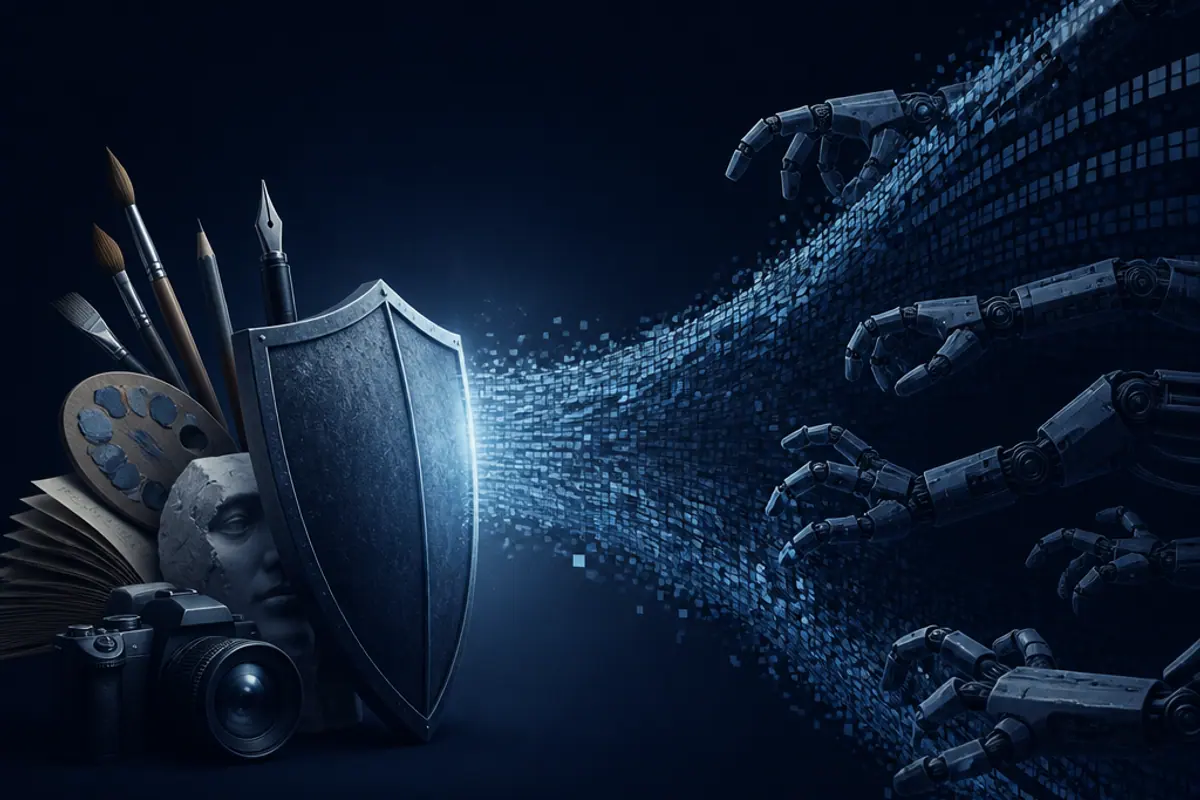
The AI copyright crisis is the unresolved legal and ethical conflict over generative AI models being trained on copyrighted creative work without the permission or payment of the people who made it. Every AI model is built on stolen creativity. Every generated image contains fragments of artists who'll never see a penny. Copyright law is dying, and Silicon Valley is holding the pillow.
DALL-E generates "original" artwork by synthesising millions of copyrighted images. ChatGPT writes in the style of specific authors by training on their copyrighted books. Midjourney creates illustrations by blending the work of photographers who never consented to their use.
This isn't inspiration - it's industrialised plagiarism with a user-friendly interface.
The AI industry calls it "training data." Artists call it theft. Copyright law, designed to protect human creativity, is being systematically dismantled by algorithms that treat all human expression as raw material for machine learning.
When Spotify uses a song in an advertisement, they pay royalties. When Netflix adapts a book, they pay licensing fees. When AI companies use millions of creative works to train their models, they pay nothing and claim fair use.
The result: An entire economy built on unpaid creative labour, justified by technological inevitability.
The Anatomy of AI Appropriation
Here's how AI training actually works, stripped of Silicon Valley euphemisms:
Step 1: Mass acquisition. AI companies scrape millions of copyrighted works from the internet - books, articles, photographs, artwork, music, code. No permission requested, no compensation offered.
Step 2: Pattern extraction. Machine learning algorithms analyse these works to understand styles, techniques, and creative patterns. They learn what makes Hemingway sound like Hemingway, what makes a Monet look like a Monet.
Step 3: Synthetic generation. Users request content "in the style of" specific creators. The AI produces work that mimics the distinctive creative voice it learned from copyrighted training data.
Step 4: Commercial exploitation. The AI-generated content competes directly with human creators, often at a fraction of the cost, using the creative patterns extracted from their own work.
It's like opening a restaurant that perfectly mimics Gordon Ramsay's recipes, cooking techniques, and presentation style - then claiming you don't owe him anything because you "learned" rather than "copied."
The Scale of Creative Appropriation
The scale is substantial:
Large language models are trained on vast text corpora drawn from books, articles, and websites, much of it copyrighted and none of it compensated.
Image generation models are trained on huge sets of image-text pairs scraped from the internet, a significant share containing copyrighted photographs and artwork.
Code generation tools are trained on large volumes of code from public repositories, including copyrighted proprietary software inadvertently made public.
Each model represents one of the largest appropriations of creative work in recent history. Training datasets of this scale dwarf any prior commercial use of copyrighted material without permission.
The "Fair Use" Fiction
AI companies defend training on copyrighted content as "fair use" - the legal doctrine that allows limited use of copyrighted material for purposes like criticism, commentary, or education.
This defence is legally dubious and morally bankrupt.
Fair use is meant to protect activities like book reviews, academic research, and parody. It was never intended to legitimise commercial competitors appropriating the entire creative output of an industry to build competing products.
Traditional fair use criteria:
Purpose: Educational, critical, or transformative vs commercial
Nature: Factual vs creative works
Amount: Small portions vs entire works
Market impact: Minimal vs direct competition
AI training fails every test:
Purpose: Purely commercial - building products to compete with creators
Nature: Specifically targets creative works for their expressive value
Amount: Uses entire works, often entire catalogues of creators' output
Market impact: Creates direct commercial competition using creators' own styles
If AI training is fair use, then copyright has no meaningful protection. Any commercial entity could "train" on any creative work for any competitive purpose.
The Creator Economy Collapse
The impact on human creators is already visible:
Freelance illustrators report significant drops in commissioned work as clients switch to AI generation, which costs a fraction of a traditional commission.
Stock photographers watch as AI-generated images flood royalty-free marketplaces, eliminating demand for human-created photos.
Content writers compete against AI that can produce "good enough" copy in seconds, driving rates below subsistence levels.
Artists discover their distinctive styles being replicated by AI tools trained specifically on their portfolios, creating direct competition from their own creative patterns.
Software developers see AI code generation tools trained on their open-source contributions now competing with their paid services.
But the cruelest irony: The better an AI becomes at mimicking human creativity, the more human creative work it required to train on. Success is measured by how effectively machines can replace the humans whose work made them possible.
The "Democratisation" Lie
Tech executives frame AI-generated content as "democratising creativity" - giving everyone access to artistic capabilities previously reserved for trained professionals.
This is corporate doublespeak for eliminating creative professionals.
True democratisation would be making creative tools more accessible, education more affordable, or collaboration easier. AI generation is industrial automation disguised as empowerment.
When a tool trained on millions of professional artists' work enables anyone to generate "professional-quality" art in seconds, it's not democratising art - it's devaluing artistic skill and destroying the economic foundation that supports professional creativity.
Imagine if we "democratised" surgery by training AI on medical procedures, then claiming anyone could perform operations because they had AI assistance. The democratisation rhetoric collapses when applied to any profession we actually respect.
The Consent Crisis
The most fundamental violation is the complete absence of consent. Artists, writers, photographers, and creators had no opportunity to opt out of AI training. Their life's work was appropriated without permission, notification, or compensation.
**Some creators are discovering their specific styles can be replicated with prompts like *****"in the style of [their name]."*** Their creative identity - developed over decades of practice - has become a dropdown menu option in AI tools.
Major corporations built human-sized meat grinders and fed creativity into them, then expressed surprise that creativity was getting ground up.
Post-hoc opt-out mechanisms are insulting. After training AI on someone's entire creative output, offering them the chance to "request removal from future training" is like stealing someone's car, then graciously offering not to steal their next one.
The Legal Reckoning
Multiple lawsuits are challenging AI training practices:
Authors vs OpenAI: Prominent writers including George R.R. Martin and Jonathan Franzen are suing over ChatGPT's training on copyrighted books.
Artists vs Stability AI: Visual artists are challenging Stable Diffusion's training on copyrighted artwork without consent.
Photographers vs Midjourney: Professional photographers are suing over image generation tools trained on their copyrighted work.
Developers vs GitHub: Programmers are challenging Copilot's training on copyrighted code repositories.
The outcomes will determine whether copyright survives the AI era. If courts rule that commercial AI training qualifies as fair use, copyright protection becomes meaningless for any work that can be digitised.
Beyond Legal: The Moral Question
Even if AI training is ultimately deemed legal, the moral question remains:
Is it right to build trillion-dollar industries on unpaid creative labour?
When Spotify revolutionised music distribution, artists still received royalties (however small). When Netflix disrupted film distribution, creators still received compensation. When Amazon transformed publishing, authors still earned from book sales.
AI is the first technology platform that eliminates creator compensation entirely. It extracts value from creative work while providing no mechanism for creators to benefit from that extraction.
This isn't creative destruction - it's creative extraction without compensation.
The Innovation Defence
AI advocates argue that restricting training data would slow innovation and cede competitive advantage to less scrupulous actors, including firms and jurisdictions less concerned with copyright protection.
This is the argument of every extractive industry throughout history. Oil companies claimed environmental regulations would hurt competitiveness. Tobacco companies argued health restrictions would disadvantage American firms. Sweatshop operators insisted labour protections would move jobs overseas.
Innovation built on exploitation isn't progress - it's sophisticated theft.
The choice isn't between AI advancement and stagnation. It's between ethical AI development that compensates creators and exploitative AI development that treats human creativity as free raw material.
Building Ethical AI Training
Responsible AI development would look different:
Consent-based training: Using only content from creators who explicitly agreed to AI training, preferably with compensation structures.
Creator revenue sharing: Platforms that distribute AI-generated content sharing revenue with the creators whose work enabled the training.
Attribution mechanisms: AI tools that can identify and credit the training sources that most influenced specific outputs.
Licensing partnerships: Formal agreements with publishers, artists' collectives, and creator organisations to license training data fairly.
Opt-in rather than opt-out: Making AI training an explicit choice rather than a default assumption.
The Future of Human Creativity
Copyright law evolved to incentivise human creativity by ensuring creators could benefit economically from their work. If AI eliminates that economic incentive, what happens to human creative development?
Why develop artistic skills if AI can replicate any style instantly? Why write novels if AI can produce bestseller-quality fiction on demand? Why learn photography if AI can generate any image imaginable?
The risk isn't just economic displacement - it's the erosion of human creative culture itself. When machines can produce "good enough" creativity using patterns extracted from human work, the incentive to develop human creative capabilities disappears.
**We may be training AI to make human creativity economically obsolete using the very human creativity we're making obsolete.
**
The Choice Before Us
Copyright's last stand isn't just about legal doctrine - it's about whether human creativity has economic value in an age of machine generation.
We can choose ethical AI development that respects creator rights and builds sustainable creative economies. Or we can allow the current system to continue until human creativity becomes an economically extinct profession.
- The AI industry framed this as a choice between innovation and stagnation. The real choice is between exploitation and sustainability.
Copyright law is dying. The question is whether we'll let it die quietly while Silicon Valley holds the pillow, or fight to preserve the economic foundation that makes human creativity viable.
- Every time we use AI-generated content without questioning its training sources, we vote for a future where human creativity has no economic value.
The future of human creative culture hangs in the balance. Choose wisely.
Creative work deserves protection and compensation in the AI era. Ensure your AI implementations respect intellectual property rights with VerityAI's comprehensive compliance framework, building sustainable technology that supports rather than exploits human creativity.
For hands-on help, see VerityAI's our AI governance practice.
Frequently asked questions
What is the AI copyright crisis?
The AI copyright crisis is the unresolved legal and ethical conflict over AI companies training models on copyrighted creative work without the permission or payment of the people who made it. Writers, artists, photographers, and developers argue their work was used without consent. AI companies argue the use qualifies as fair use because the output is a new creation rather than a direct copy.
Is training AI on copyrighted material legal?
The legal position isn't settled. Multiple lawsuits are working through courts in different jurisdictions, and outcomes so far have varied depending on the specific facts of each case. Businesses using generative AI tools should treat this as an open legal question rather than a resolved one.
What is "fair use" and does it cover AI training?
Fair use is a legal doctrine that allows limited use of copyrighted material without permission, for purposes such as criticism, commentary, or education. Whether it extends to commercial AI training on entire creative catalogues is exactly what current litigation is testing, and courts haven't reached a consistent answer.
What should businesses do about AI copyright risk?
Businesses using generative AI tools should understand where their vendor's training data came from, review licensing terms carefully, and build a human review step in before publishing AI-assisted creative output. Waiting for full legal clarity before taking basic precautions leaves a business exposed in the meantime.

Sotiris Spyrou
Sotiris Spyrou is the founder of VerityAI, a Responsible AI advisory for boards and AI-deploying businesses. With 27 years across agencies and global in-house roles, including Global Head of SEO at Robert Half and Group Head of Search at Gamesys, he advises leaders on AI governance and risk, and on answer-engine visibility engineered without the dark patterns the rest of the industry is getting penalised for. He is the author of TRANSFORM, AI Moats, and Ethical AI.
Founder at VerityAI
Areas of Expertise: