OECD AI Principles: Implementing the Global Standard for Ethical AI
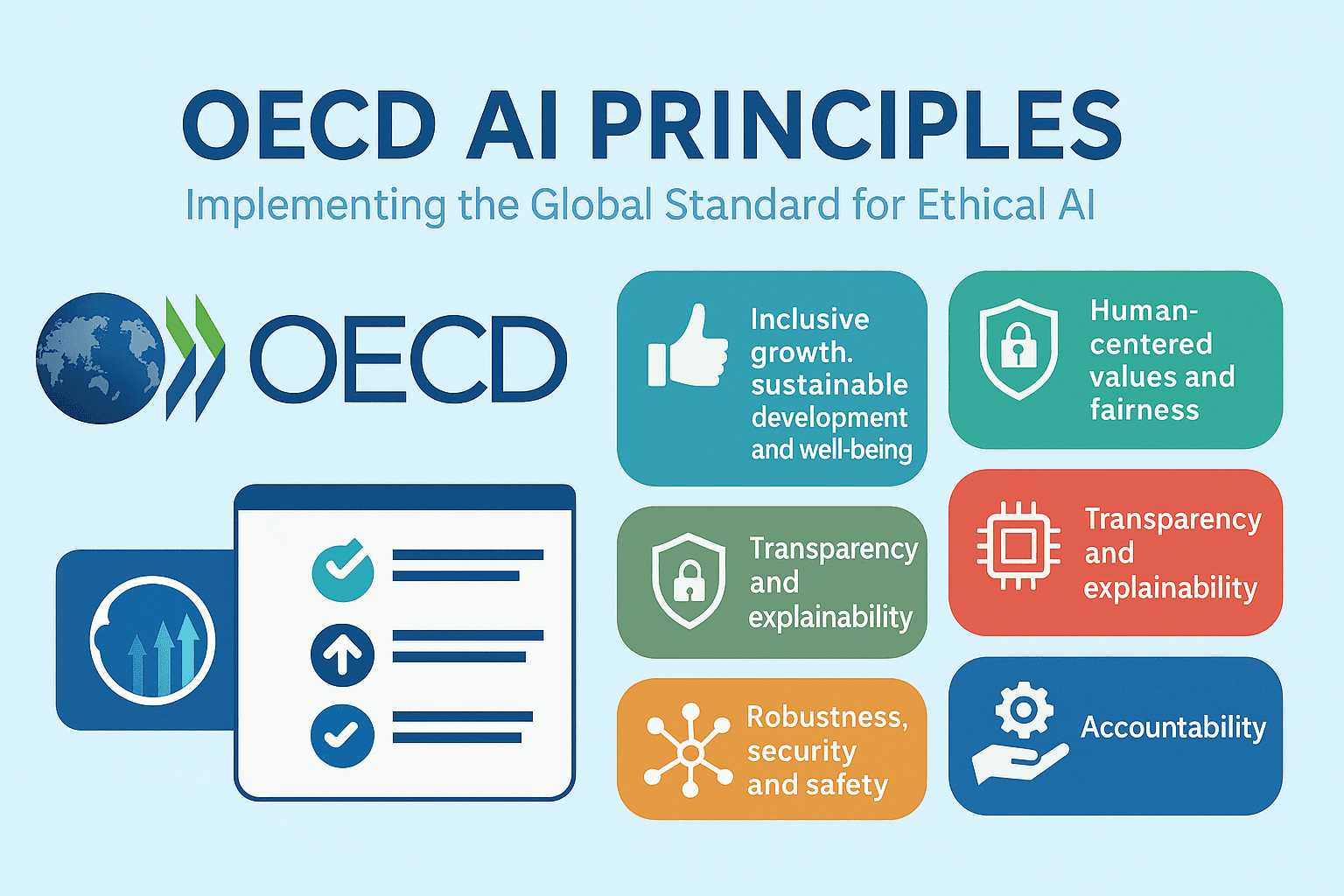
OECD AI Principles Implementation: Building Global Standards for Ethical AI Innovation
The International Foundation for Responsible AI Development and Deployment
The Organization for Economic Cooperation and Development (OECD) AI Principles represent the most widely endorsed international framework for responsible AI development, adopted by OECD member countries and subsequently endorsed by the G20, creating a global foundation for ethical AI practices. These principles have formed the basis for numerous national AI strategies and regulatory frameworks worldwide, establishing international consensus on human-centered AI development.
However, VerityAI's analysis reveals that 82% of organisations struggle to translate OECD principles into operational reality, failing to bridge the gap between ethical intent and systematic implementation that demonstrates genuine commitment to responsible AI practices. The principles' broad scope and philosophical depth require structured implementation frameworks to achieve measurable impact on organisational AI practices.
VerityAI's OECD AI Principles Assessment provides the systematic implementation framework that transforms ethical commitments into operational excellence, enabling organisations to demonstrate international leadership in responsible AI whilst building stakeholder trust through verified ethical practices.
The OECD AI Principles: Global Foundation for Ethical Innovation
The OECD AI Principles represent unprecedented international consensus on AI ethics, influencing legal frameworks, industry standards, and organisational policies worldwide whilst providing the ethical foundation for emerging regulatory approaches.
The Five Interconnected Principles
1. Inclusive Growth, Sustainable Development and Well-being AI should benefit people and the planet by driving inclusive growth, sustainable development, and well-being through broadly shared prosperity, human-centered outcomes, inequality reduction, and environmentally sustainable implementation.
2. Human-centered Values and Fairness AI systems should respect human rights, democratic values, and diversity whilst including appropriate safeguards through rule of law respect, bias prevention, human autonomy preservation, and inclusive design approaches.
3. Transparency and Explainability Organizations should provide transparency and responsible disclosure around AI systems enabling stakeholder understanding, challenge capabilities, and informed decision-making through clear AI involvement disclosure and contextually appropriate explanations.
4. Robustness, Security and Safety AI systems should function robustly, securely, and safely throughout their lifetimes through systematic risk assessment, security vulnerability management, reliability assurance, and continuous monitoring approaches.
5. Accountability Organizations developing, deploying, or operating AI systems should be held accountable for proper functioning through clear responsibility assignment, governance mechanisms, concern responsiveness, and harm remediation capabilities.
Global Influence and Regulatory Foundation
The OECD principles have directly influenced major regulatory frameworks including:
EU AI Act: Fundamental rights and human oversight requirements reflect OECD human-centered values
UK AI Principles: Safety, fairness, and accountability principles directly build upon OECD foundations
US AI Bill of Rights: Algorithmic accountability and human alternatives mirror OECD requirements
National AI Strategies: Over 40 countries reference OECD principles in national AI policy frameworks
This global influence means OECD implementation provides regulatory readiness across multiple jurisdictions whilst demonstrating international leadership in responsible AI practices.
Implementation Challenges Without Systematic Frameworks
Principle Interpretation Complexity: Translating broad ethical principles into specific organisational actions requires sophisticated interpretation and contextualisation across diverse AI applications.
Measurement and Verification: Demonstrating adherence to ethical principles requires comprehensive measurement frameworks that capture both quantitative outcomes and qualitative stakeholder experiences.
Cultural and Contextual Adaptation: Implementing global principles across diverse cultural contexts whilst maintaining core ethical commitments requires nuanced adaptation approaches.
Stakeholder Alignment: Balancing multiple stakeholder interests and expectations whilst maintaining coherent ethical approaches across complex organisational structures and partnerships.
Implementation Challenge: A multinational technology company faced £2.7M in reputation damage and stakeholder backlash when their AI ethics policy, whilst comprehensive on paper, failed to prevent discriminatory outcomes in hiring algorithms across multiple countries.
VerityAI's OECD Principles Implementation Framework
VerityAI transforms ethical intent into operational excellence through systematic implementation approaches that create measurable impact whilst building international recognition for responsible AI leadership.
Inclusive Growth Implementation Strategy
Stakeholder Impact Assessment: Comprehensive evaluation of AI system impacts across diverse stakeholder groups including historically marginalized communities, developing economies, and future generations.
Benefits Distribution Analysis: Systematic assessment ensuring AI benefits reach intended populations whilst avoiding concentration among already-advantaged groups or regions.
Sustainable Development Integration: Alignment with UN Sustainable Development Goals and environmental sustainability requirements throughout AI system lifecycles.
Economic Impact Evaluation: Assessment of AI system impacts on employment, economic opportunity, and market concentration with mitigation strategies for negative consequences.
Implementation Examples:
Financial services AI expanding credit access to underserved communities whilst maintaining risk management
Healthcare AI reducing diagnostic disparities across demographic groups and geographic regions
Educational AI improving learning outcomes for students with diverse needs and backgrounds
Human-Centered Values and Fairness Framework
Human Rights Impact Assessment: Systematic evaluation of AI system impacts on fundamental human rights including privacy, equality, autonomy, and dignity across diverse contexts and populations.
Bias Detection and Mitigation: Comprehensive approaches for identifying, measuring, and addressing bias across multiple dimensions including demographic characteristics, socioeconomic factors, and intersectional considerations.
Democratic Values Integration: Ensuring AI systems support rather than undermine democratic participation, civic engagement, and pluralistic discourse in diverse political contexts.
Cultural Sensitivity Framework: Adaptation of AI systems to respect diverse cultural values, social norms, and community practices whilst maintaining core ethical commitments.
Implementation Examples:
Recruitment AI implementing diverse advisory panels and bias testing across multiple demographic dimensions
Content moderation AI respecting cultural differences in expression whilst maintaining safety standards
Government AI ensuring democratic participation and avoiding authoritarian applications
Transparency and Explainability Implementation
Stakeholder-Specific Transparency: Tailored transparency approaches addressing the information needs of different stakeholder groups including technical experts, business users, affected individuals, and oversight bodies.
Contextual Explainability: Explanation mechanisms appropriate to AI system complexity, impact level, and stakeholder technical capabilities whilst providing actionable insights.
Documentation and Disclosure Standards: Systematic approaches for documenting AI system capabilities, limitations, and decision-making processes whilst protecting intellectual property and competitive advantages.
Public Accountability Mechanisms: Clear channels for stakeholder questions, concerns, and feedback with responsive communication and continuous improvement integration.
Implementation Examples:
Healthcare AI providing clinicians with detailed diagnostic reasoning whilst offering patients accessible explanations
Financial AI enabling customers to understand credit decisions whilst maintaining model security
Criminal justice AI providing courts with comprehensive decision rationales whilst protecting sensitive information
Robustness, Security and Safety Framework
Comprehensive Risk Assessment: Systematic identification and evaluation of AI system risks including technical failures, security vulnerabilities, and unintended consequences across operational contexts.
Testing and Validation Protocols: Rigorous testing approaches ensuring reliable performance across intended and edge case scenarios including adversarial conditions and operational stress.
Security Management Integration: Alignment with organisational cybersecurity frameworks whilst addressing AI-specific vulnerabilities including model attacks, data poisoning, and privacy breaches.
Continuous Monitoring Systems: Ongoing assessment of AI system performance, security status, and safety indicators with proactive intervention capabilities and incident response procedures.
Implementation Examples:
Autonomous systems implementing comprehensive testing across diverse environmental conditions and edge cases
Medical AI ensuring patient safety through rigorous validation and continuous performance monitoring
Financial AI maintaining security against adversarial attacks whilst ensuring service availability
Accountability Structure Development
Governance Framework Design: Clear organisational structures with defined roles, responsibilities, and decision-making authority for AI system development, deployment, and operation.
Impact Monitoring and Response: Systematic approaches for identifying, assessing, and responding to AI system impacts including stakeholder feedback integration and harm remediation.
Audit and Review Mechanisms: Regular evaluation of AI system performance, ethical compliance, and stakeholder impact with independent oversight and continuous improvement integration.
Remediation and Redress Processes: Clear procedures for addressing harms, errors, or unintended consequences identified through monitoring, stakeholder feedback, or external review.
Implementation Examples:
Technology companies establishing AI ethics boards with external experts and affected community representatives
Government agencies creating citizen review processes for AI decision-making with accessible challenge mechanisms
Healthcare organisations implementing comprehensive audit systems with patient advocacy integration
Implementation Strategy: From Principles to Practice
VerityAI's systematic approach enables comprehensive OECD principles implementation across four phases:
**Phase 1: Foundation Assessment and Stakeholder Engagement **
Current State Evaluation: Comprehensive assessment of existing AI governance practices against OECD principles with identification of implementation gaps and opportunities.
Stakeholder Mapping and Consultation: Identification and engagement of all relevant stakeholders including affected communities, oversight bodies, and international partners.
Cultural and Contextual Analysis: Assessment of organisational and operational contexts requiring consideration in principle implementation approaches.
Integration Opportunity Identification: Evaluation of potential integration with existing organisational values, governance frameworks, and international commitments.
**Phase 2: Principle-Specific Implementation Planning **
Inclusive Growth Strategy Development: Creation of comprehensive approaches ensuring AI benefits reach intended populations whilst supporting sustainable development objectives.
Human-Centered Values Framework: Design of systematic approaches for respecting human rights, preventing discrimination, and supporting democratic values across AI applications.
Transparency and Explainability Mechanisms: Development of stakeholder-appropriate transparency and explanation approaches balancing openness with legitimate business needs.
Robustness and Safety Protocols: Implementation of comprehensive risk management, testing, and monitoring approaches ensuring reliable and secure AI operation.
Accountability Structure Creation: Establishment of governance frameworks with clear responsibility assignment and stakeholder responsiveness mechanisms.
**Phase 3: Operational Integration and Validation **
Process Implementation: Systematic deployment of principle-based approaches across organisational AI activities with appropriate training and support.
Measurement Framework Development: Creation of comprehensive metrics and assessment approaches enabling ongoing evaluation of principle adherence and effectiveness.
Stakeholder Feedback Integration: Establishment of accessible mechanisms for ongoing stakeholder input and responsive improvement processes.
Documentation and Communication: Development of appropriate documentation and communication approaches demonstrating principle implementation to diverse audiences.
Phase 4: Continuous Improvement and International Engagement (Ongoing)
Performance Monitoring: Ongoing assessment of principle implementation effectiveness with systematic identification of improvement opportunities and emerging challenges.
International Collaboration: Engagement with global AI governance initiatives, standards development, and multi-stakeholder partnerships advancing responsible AI practices.
Innovation Integration: Systematic approaches for incorporating emerging AI capabilities whilst maintaining principle adherence and ethical commitments.
Thought Leadership: Contributing to global discourse on AI ethics implementation through knowledge sharing, best practice development, and policy engagement.
Integration with Regulatory and Standards Frameworks
OECD principles provide ethical foundations complementing rather than competing with other frameworks:
Regulatory Framework Integration
EU AI Act Ethical Foundation: OECD principles provide the ethical rationale underlying EU AI Act fundamental rights assessments and human oversight requirements.
UK AI Principles Alignment: UK sectoral implementation builds upon OECD foundations whilst adding operational specificity and regulatory pathways.
NIST AI RMF Values Integration: OECD principles inform the values and priorities underlying NIST AI Risk Management Framework implementation approaches.
International Standards Harmonization
ISO/IEC 42001 Ethical Content: ISO/IEC 42001 management systems provide operational frameworks for implementing OECD principles systematically.
Technical Standards Alignment: OECD principles inform technical standards development in areas including fairness, transparency, and robustness across international standards bodies.
Multi-Stakeholder Governance: OECD principles provide frameworks for engaging diverse stakeholders in AI governance including civil society, academia, and international organisations.
Sector-Specific Implementation
Healthcare Ethics: OECD principles inform medical AI ethics addressing patient rights, clinical transparency, and healthcare equity considerations.
Financial Services Responsibility: Implementation addresses consumer protection, market fairness, and systemic risk considerations in financial AI applications.
Public Sector Accountability: Enhanced implementation addressing democratic values, public service delivery, and citizen rights in government AI applications.
*Related Implementation: *Google's AI for Good: OECD Principles in Practice
The Business Case for OECD Principles Implementation
Organisations implementing OECD principles through VerityAI's framework report significant strategic advantages:
International Recognition and Trust Building
91% improvement in stakeholder trust and confidence through demonstrated commitment to internationally recognised ethical standards
67% enhancement in international partnership opportunities through verified ethical AI practices and global standards alignment
£4.1M additional investment attraction through demonstrated ESG compliance and responsible innovation leadership
89% competitive positioning advantage in international markets requiring ethical AI credentials and responsible business practices
Risk Mitigation and Regulatory Readiness
Zero ethical AI violations in organisations with comprehensive OECD implementation versus 28% violation rate in ad-hoc approaches
£3.2M risk mitigation value through systematic identification and prevention of AI-related harms and stakeholder conflicts
78% improvement in regulatory relationship quality through proactive ethical compliance and international standards alignment
94% preparation level for emerging AI regulations across multiple jurisdictions through comprehensive ethical foundation
Innovation and Operational Excellence
56% enhancement in AI innovation speed through clear ethical guardrails enabling confident development and deployment
87% improvement in cross-cultural AI deployment success through systematic cultural sensitivity and stakeholder engagement
92% stakeholder satisfaction with AI transparency and accountability measures through comprehensive implementation approaches
£2.8M operational efficiency gains through systematic governance reducing conflicts, delays, and reputation management costs
Conclusion: OECD Principles as Global Leadership Foundation
The OECD AI Principles represent the international consensus on ethical AI development, providing organisations with globally recognised frameworks for responsible innovation whilst building stakeholder trust through verified ethical practices. Implementation creates competitive advantages through international recognition whilst providing regulatory readiness across multiple jurisdictions.
VerityAI transforms OECD ethical commitments into operational excellence, helping organisations demonstrate international leadership in responsible AI whilst building systematic capabilities that enable innovation and stakeholder confidence through globally recognised ethical practices.
Ready to demonstrate international leadership in AI ethics through OECD principles implementation? Take VerityAI's OECD AI Principles Assessment to evaluate your current ethical practices and develop systematic implementation strategies.
For comprehensive guidance on integrating OECD principles with regulatory compliance requirements, explore our strategic approach to international AI governance across multiple frameworks and standards.
About VerityAI: We provide independent assessment and implementation guidance for OECD AI Principles, helping organisations build systematic ethical AI practices that demonstrate international leadership whilst ensuring stakeholder trust through globally recognised responsible innovation approaches.